Market outperformance requires a disciplined and unemotional approach. Going left when the herd is going right is the most difficult process to undertake. It requires an unwavering conviction in your data and reasoning.
"You are neither right or wrong because the crowd disagrees with you. You are right because your data and reasoning are right." - Ben Graham
Thus, in studying the greatest (Buffett, Schloss, Miller, Pabrai), I see six fundamental characteristics that they methodically practice.
Each and every day, I put these six principles to work for the Gad Partners Fund.
1. A Sound Investment Philosophy (Ben Graham, Value Investing)
2. A Good Search Strategy
3. Ability to value a business and assess the quality of management.
4. The discipline to say no.
5. Patience
6. Courage to make a significant investment at the maximum point of pessimism.
Sunday, August 12, 2007


Sunday, July 29, 2007
The Three Most UnderValued Words in Investing: MARGIN OF SAFETY
Margin of Safety.
These words were officially brought to light in The Intelligent Investor by Ben Graham. And when you mention them to most money managers, they nod in approval and understanding. Yet, statistical performance results tell you another story. When 8 out of 10 mutual funds fail to be the benchmark, it means fund managers are simply over paying for businesses.
Only three types of investments exist -
1. under priced,
2. fairly priced, and
3. overpriced.
Value investors, by nature, engage in only three activities:
1. Buy the under priced assets
2. Hold or sell the fairly priced assets.
3. Avoid the over priced assets.
Yet finding under priced assets is not easy nor should it be. Further, an asset's intrinsic value is not an exact number but instead a value determined by several analytical inputs based on data and reasoning. Having a satisfactory margin of safety protects the intelligent investor from engaging in folly that results in a permanent loss of capital.
Ben Graham succinctly put it when he said,
"An investment operation is one which, upon thorough analysis, promises safety of principal and a satisfactory return. Operations not meeting these requirements are speculative."
Whether or not money managers realize it, most "investments" are more often just mere speculative activities hinging upon the actions of management and the future results of the business. Of course in a bull market, speculation is mistaken for investing. Bull markets tend to disguise everyone as an investing genius. But we all know that a value investor is more focused on making it through bear market storms relatively unscathed.
Buffett said it best in his letter to his limited partners in 1961:
"I would consider a year in which we decline 15% and the [Dow Jones] average 30% to be much superior to a year when both we and the average advanced 20%."
Most investors don't fully grasp this investing approach, and the result is inferior long-term performance relative to the benchmarks. Value investors always demand a margin of safety. And a margin of safety can come in various forms, but its sole purpose is to diminish the probability of a permanent loss of capital. Most important, the margin of safety insulates the enterprising investor from the inevitable surprises that Mr. Market may have up his sleeve.
Finally, remember that the intrinsic value of a business changes over time, and therefore, so will the margin of safety. A 50% margin of safety one year may erode or widen the following year. If your assessment of intrinsic value changes, then so must your investment decision - to either buy more of a now more under priced assets with a greater margin of safety, or dispose of a 50 cent dollar that has now become a 90 cent dollar. Either way, all roads lead to one path in which you come out with minimal loss of capital.
Price is what you pay, value is what you get.
For more on margin of safety, check out my write up on at the Motley Fool:
http://www.fool.com/investing/value/2007/07/23/security-analysis-101-margin-of-safety.aspx?terms=margin+of+safety&vstest=search_042607_linkdefault
These words were officially brought to light in The Intelligent Investor by Ben Graham. And when you mention them to most money managers, they nod in approval and understanding. Yet, statistical performance results tell you another story. When 8 out of 10 mutual funds fail to be the benchmark, it means fund managers are simply over paying for businesses.
Only three types of investments exist -
1. under priced,
2. fairly priced, and
3. overpriced.
Value investors, by nature, engage in only three activities:
1. Buy the under priced assets
2. Hold or sell the fairly priced assets.
3. Avoid the over priced assets.
Yet finding under priced assets is not easy nor should it be. Further, an asset's intrinsic value is not an exact number but instead a value determined by several analytical inputs based on data and reasoning. Having a satisfactory margin of safety protects the intelligent investor from engaging in folly that results in a permanent loss of capital.
Ben Graham succinctly put it when he said,
"An investment operation is one which, upon thorough analysis, promises safety of principal and a satisfactory return. Operations not meeting these requirements are speculative."
Whether or not money managers realize it, most "investments" are more often just mere speculative activities hinging upon the actions of management and the future results of the business. Of course in a bull market, speculation is mistaken for investing. Bull markets tend to disguise everyone as an investing genius. But we all know that a value investor is more focused on making it through bear market storms relatively unscathed.
Buffett said it best in his letter to his limited partners in 1961:
"I would consider a year in which we decline 15% and the [Dow Jones] average 30% to be much superior to a year when both we and the average advanced 20%."
Most investors don't fully grasp this investing approach, and the result is inferior long-term performance relative to the benchmarks. Value investors always demand a margin of safety. And a margin of safety can come in various forms, but its sole purpose is to diminish the probability of a permanent loss of capital. Most important, the margin of safety insulates the enterprising investor from the inevitable surprises that Mr. Market may have up his sleeve.
Finally, remember that the intrinsic value of a business changes over time, and therefore, so will the margin of safety. A 50% margin of safety one year may erode or widen the following year. If your assessment of intrinsic value changes, then so must your investment decision - to either buy more of a now more under priced assets with a greater margin of safety, or dispose of a 50 cent dollar that has now become a 90 cent dollar. Either way, all roads lead to one path in which you come out with minimal loss of capital.
Price is what you pay, value is what you get.
For more on margin of safety, check out my write up on at the Motley Fool:
http://www.fool.com/investing/value/2007/07/23/security-analysis-101-margin-of-safety.aspx?terms=margin+of+safety&vstest=search_042607_linkdefault
Tuesday, July 24, 2007
Some Valuable Comments
I recently received the following comments from two readers:
1. "A few ideas, to be taken with a grain (or many grains) of salt: while it's good to talk about the articles you've written, I think most people don't like getting a detailed rundown of all of them. Perhaps writing a blog post that further expands on an article is better, that way you indirectly (thus subtle) point us blog readers in their direction...Also, perhaps posting more often? Sometimes you have really good, inspired posts. It'll probably be a challenge for you to post everyday, but even being consistent with posts every other day would help. Hey just some constructive ideas..."
These are indeed some very constructive ideas. I am sure that it would have been more informative to expand on the articles that are being written for the Fool, so I will keep this in mind. My ultimate goal was to really provide an "archive" link if you will, of my various other writings. I want this blog to be a central source for any other thoughts and ideas that I may cover outside of the blog.
The lack of consistency in the postings is something I have been aware of and I am glad someone mentioned it (hence why I took the easy way out and just gave you links to other articles). Beginning next month, my priority will naturally shift to running the Gad Partners Fund via Gad Capital Management. The blog will remain active, but it will certainly have to take a back seat. Nonetheless I will provide some new content as best I can.
I had one comment asking whether or not I would post the partnership letters on the blog. Unfortunately, because of the "hedge fund" like similarities of the partnership with respect to its legal formation, I can not advertise the partnership like a mutual fund. While posting the letters might not be considered "advertising," I feel better playing in the center of the court rather than around the edges.
2. "Congrats on getting GCM off the ground. Do you still plan on writing for fool.com and the blog once you’ve started GCM? Thanks for the blog it has helped lead me in the right direction for my investing education."
I don't deserve this compliment. There are plenty of wonderful value investors out there that have allowed me to make this blog a possibility. I am glad I can be of some help.
With regards to my future writing commitments, let me post my response to this comment:
"Yes, I still plan to continue writing for the blog, the Motley Fool, etc. I feel that the written word is very helpful to an investor. Putting my reasoning on paper is a great mental exercise for me. For example, last week I was wanting to understand the fine points of the securitization process.
As I begin to mentally gather ideas, it occurred to me that it would be very helpful to me to write down the process. The end result was an article. I wish I could say that I would contribute on a regular basis, but with the start of the partnership, the rate of postings will be a little slower, at least initially."
1. "A few ideas, to be taken with a grain (or many grains) of salt: while it's good to talk about the articles you've written, I think most people don't like getting a detailed rundown of all of them. Perhaps writing a blog post that further expands on an article is better, that way you indirectly (thus subtle) point us blog readers in their direction...Also, perhaps posting more often? Sometimes you have really good, inspired posts. It'll probably be a challenge for you to post everyday, but even being consistent with posts every other day would help. Hey just some constructive ideas..."
These are indeed some very constructive ideas. I am sure that it would have been more informative to expand on the articles that are being written for the Fool, so I will keep this in mind. My ultimate goal was to really provide an "archive" link if you will, of my various other writings. I want this blog to be a central source for any other thoughts and ideas that I may cover outside of the blog.
The lack of consistency in the postings is something I have been aware of and I am glad someone mentioned it (hence why I took the easy way out and just gave you links to other articles). Beginning next month, my priority will naturally shift to running the Gad Partners Fund via Gad Capital Management. The blog will remain active, but it will certainly have to take a back seat. Nonetheless I will provide some new content as best I can.
I had one comment asking whether or not I would post the partnership letters on the blog. Unfortunately, because of the "hedge fund" like similarities of the partnership with respect to its legal formation, I can not advertise the partnership like a mutual fund. While posting the letters might not be considered "advertising," I feel better playing in the center of the court rather than around the edges.
2. "Congrats on getting GCM off the ground. Do you still plan on writing for fool.com and the blog once you’ve started GCM? Thanks for the blog it has helped lead me in the right direction for my investing education."
I don't deserve this compliment. There are plenty of wonderful value investors out there that have allowed me to make this blog a possibility. I am glad I can be of some help.
With regards to my future writing commitments, let me post my response to this comment:
"Yes, I still plan to continue writing for the blog, the Motley Fool, etc. I feel that the written word is very helpful to an investor. Putting my reasoning on paper is a great mental exercise for me. For example, last week I was wanting to understand the fine points of the securitization process.
As I begin to mentally gather ideas, it occurred to me that it would be very helpful to me to write down the process. The end result was an article. I wish I could say that I would contribute on a regular basis, but with the start of the partnership, the rate of postings will be a little slower, at least initially."
Thursday, July 19, 2007
Three Visits with the World's Best Value Investors
When I started this blog last year, my goal was to provide the value investing perpsectives taken from the world's best investors. As we all know, a common theme amongst investors is the willingness to teach. Investing is after all, a continuous education; a game that never ends. It is these two facets of investing that really keep me going - there is always something to learn in order to expand your circle of competence, and the intelligent investor's goal is to use his knowledge to evaluate businesses and come to independent rational decisions on why he should invest. More often than not, the best investments will occur at the point of maximum pessimism, and you have to trust your reasoning when everyone around you is taking you to task.
Over the past year, I have been extremely lucky to have personally met some of the best investors on the planet.
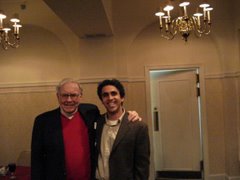
First in January of this year, I met Warren Buffett. After my mother and father, Buffett is without question the greatest influence and inspiration in my life. Without Buffett's teachings and writings, I can guarantee that I would not be the person I am today. Aside from being the greatest investor in the history of mankind, Buffett's leads a life that sets an example for all to follow. When I asked Buffett about what the most important advice he had for me, he quickly remarked, "Do what you love and make sure your kids love you." The two day visit I had with Mr. Buffett is an opportunity I will always be grateful to him for.
Secondly, this past spring, I visited with Mohnish Pabrai. I first met Mohnish last November at the Value Investing Congress in NYC. On the last day of the event, Mohnish sat next to me during breakfast. Since then, I am very proud to call Mohnish a friend. Already, Mohnish's investment record is legendary and he has decades to go. One day the world will be very grateful that Mohnish is doing what he is doing. I am grateful to call him a friend.
Thirdly, I had an opportunity to visit and spend time with Mason Hawkins. Mason Hawkins is quite simply the most underrated money manager in the business. The accomplishments he has achieved operating under the regulatory framework of the mutual fund industry is impossible to accomplish unless you're Mason Hawkins. True to his form, Mason does what he does because he loves it. As far as I'm concerned, any investor in the Longleaf Funds should name their first born child Mason. As a steward of capital, Mason Hawkins sets the standard all should follow.
In less than six months, I had the honor to spend time with three phenomenal human beings and individuals that I look up to not only for thier impeccable investing ability, but also for the example they set each day. All three were gracious with their knowledge about the world and business and most importantly, thier time. Time to give to someone like me and everyone else who's just as passionate about investing.
Some of you may be wondering why the postings on this blog have been more and more infrequent. Gad Capital Management will begin operations in about a month. GCM will be running the Gad Partners Fund, a value-centric investment partnership deeply rooted in the teachings of Graham, Buffett, Hawkins, and Pabrai. Some really terrific individuals and families have decided to join the partnership. I am very lucky to call them partners.
Over the past year, I have been extremely lucky to have personally met some of the best investors on the planet.
First in January of this year, I met Warren Buffett. After my mother and father, Buffett is without question the greatest influence and inspiration in my life. Without Buffett's teachings and writings, I can guarantee that I would not be the person I am today. Aside from being the greatest investor in the history of mankind, Buffett's leads a life that sets an example for all to follow. When I asked Buffett about what the most important advice he had for me, he quickly remarked, "Do what you love and make sure your kids love you." The two day visit I had with Mr. Buffett is an opportunity I will always be grateful to him for.
Secondly, this past spring, I visited with Mohnish Pabrai. I first met Mohnish last November at the Value Investing Congress in NYC. On the last day of the event, Mohnish sat next to me during breakfast. Since then, I am very proud to call Mohnish a friend. Already, Mohnish's investment record is legendary and he has decades to go. One day the world will be very grateful that Mohnish is doing what he is doing. I am grateful to call him a friend.
Thirdly, I had an opportunity to visit and spend time with Mason Hawkins. Mason Hawkins is quite simply the most underrated money manager in the business. The accomplishments he has achieved operating under the regulatory framework of the mutual fund industry is impossible to accomplish unless you're Mason Hawkins. True to his form, Mason does what he does because he loves it. As far as I'm concerned, any investor in the Longleaf Funds should name their first born child Mason. As a steward of capital, Mason Hawkins sets the standard all should follow.
In less than six months, I had the honor to spend time with three phenomenal human beings and individuals that I look up to not only for thier impeccable investing ability, but also for the example they set each day. All three were gracious with their knowledge about the world and business and most importantly, thier time. Time to give to someone like me and everyone else who's just as passionate about investing.
Some of you may be wondering why the postings on this blog have been more and more infrequent. Gad Capital Management will begin operations in about a month. GCM will be running the Gad Partners Fund, a value-centric investment partnership deeply rooted in the teachings of Graham, Buffett, Hawkins, and Pabrai. Some really terrific individuals and families have decided to join the partnership. I am very lucky to call them partners.
Monday, July 16, 2007
Value Investing Articles at The Motley Fool
Some of you may know that I was offerred a great opportunity to post articles and other value investing musings on the Motley Fool. Below are some links to the articles.
"The Intelligent Investor's Investment"
http://www.fool.com/investing/value/2007/06/27/the-intelligent-investors-investment.aspx?vstest=search_042607_linkdefault
Buffett and Pabrai Break Bread
http://www.fool.com/investing/general/2007/07/02/buffett-and-pabrai-break-bread.aspx?vstest=search_042607_linkdefault
Investing Lessons From Benjamin Graham
http://www.fool.com/investing/small-cap/2007/06/12/investing-lessons-from-benjamin-graham.aspx?vstest=search_042607_linkdefault
Long-Term Riches on Tap
http://www.fool.com/investing/small-cap/2007/06/05/long-term-riches-on-tap.aspx?vstest=search_042607_linkdefault
The Skinny on Sub-Prime
http://www.fool.com/investing/value/2007/07/10/the-skinny-on-subprime.aspx?vstest=search_042607_linkdefault
"The Intelligent Investor's Investment"
http://www.fool.com/investing/value/2007/06/27/the-intelligent-investors-investment.aspx?vstest=search_042607_linkdefault
Buffett and Pabrai Break Bread
http://www.fool.com/investing/general/2007/07/02/buffett-and-pabrai-break-bread.aspx?vstest=search_042607_linkdefault
Investing Lessons From Benjamin Graham
http://www.fool.com/investing/small-cap/2007/06/12/investing-lessons-from-benjamin-graham.aspx?vstest=search_042607_linkdefault
Long-Term Riches on Tap
http://www.fool.com/investing/small-cap/2007/06/05/long-term-riches-on-tap.aspx?vstest=search_042607_linkdefault
The Skinny on Sub-Prime
http://www.fool.com/investing/value/2007/07/10/the-skinny-on-subprime.aspx?vstest=search_042607_linkdefault
Tuesday, July 3, 2007
Pabrai Wins Bid to Lunch with Warren Buffett
Mohnish Pabrai recently bid $650,100 to have lunch with Warren Buffett. According to Mohnish, his winning bid was a overdue "tuition payment" to the man who has taught so many.
Lest you think that this was a ridiculous sum of money to fork over for lunch with anyone, I would like to invite you to read my following article at the Motley Fool:
http://www.fool.com/investing/general/2007/07/02/buffett-and-pabrai-break-bread.aspx
By looking at this lunch from several angles, you begin to realize that this lunch bid was a typical Pabrain value play.
This morning, CNBC interviewed Mohnish about his winning bid. (Thanks to Lincoln Minor for graciously sharing valuable information on all things value investing)
http://www.cnbc.com/id/15840232?video=408046817&play=1
Lest you think that this was a ridiculous sum of money to fork over for lunch with anyone, I would like to invite you to read my following article at the Motley Fool:
http://www.fool.com/investing/general/2007/07/02/buffett-and-pabrai-break-bread.aspx
By looking at this lunch from several angles, you begin to realize that this lunch bid was a typical Pabrain value play.
This morning, CNBC interviewed Mohnish about his winning bid. (Thanks to Lincoln Minor for graciously sharing valuable information on all things value investing)
http://www.cnbc.com/id/15840232?video=408046817&play=1
Thursday, June 21, 2007
Interview Clips with Mohnish Pabrai
Mohnish Pabrai was interviewed on Bloomberg on June 19, 2007.
Thanks to Lincoln Minor for sharing these wonderful video clips:
Part 1 http://wpi.clipsyndicate.com/publish/index/339725
Part 2 http://wpi.clipsyndicate.com/publish/index/339737
Thanks to Lincoln Minor for sharing these wonderful video clips:
Part 1 http://wpi.clipsyndicate.com/publish/index/339725
Part 2 http://wpi.clipsyndicate.com/publish/index/339737
Tuesday, June 5, 2007
The Principle of [Value] Investing
I often hear the term "value investing," too much to the point where I begin asking myself two fundamental questions:
1. What do people really mean when they say that they are value investing?
2. What makes a value investor?
Let's be clear from the start. Ben Graham was an investor. Warren Buffett is an investor. Mason Hawkins is an investor. The term value investing was given to their style simply to define what they do best: finding valuable--companies worth more than their current market price--investments.
In my opinion, the best definition of an investment was given by Ben Graham in Security Analysis:
“An investment operation is one which, upon thorough analysis, promises safety of principal and a satisfactory return. Operations not meeting these requirements are speculative.”
1. What do people really mean when they say that they are value investing?
2. What makes a value investor?
Let's be clear from the start. Ben Graham was an investor. Warren Buffett is an investor. Mason Hawkins is an investor. The term value investing was given to their style simply to define what they do best: finding valuable--companies worth more than their current market price--investments.
In my opinion, the best definition of an investment was given by Ben Graham in Security Analysis:
“An investment operation is one which, upon thorough analysis, promises safety of principal and a satisfactory return. Operations not meeting these requirements are speculative.”
So there it is. A simple, yet elegant definition of what investing ought to be. If you want to call it value investing, be prepared to explain what that really means. When Charlie Munger remarked "all intelligent investing is value investing," he knew exactly what he was saying. If you say you are a value investor, then without exception, you should be applying the three qualifications that Ben Graham laid down over seventy years ago. Each investment should be made only after a detailed assessment of the facts, a compelling valuation that provides a margin of safety, and a return that is better than other viable options adjusted for risk. I would be willing to wager that at least 75% of so called value investors don't come close to passing the test. You can forget about the majority of mutual funds with the name "Value" in them, as they define their investment operation as low P/E, low P/B stock picking.
Charlie Munger said it best when he remarked:
"Our investment style has been given a name - focus investing - which implies ten holdings, not one hundred or four hundred. The idea that it is hard to find good investments, so concentrate in a few, seems to me to be an obvious idea. But 98% of the investment world does not think this way. It's been good for us."
The number one key to a intelligent investing approach is discipline. Discipline is what prevents you from losing money. Preservation of capital is name of the game. I am glad I got a [relatively] early start in investing my own money, because when I look back at my approach, it wasn't truly the prudent approach outlined by Graham. It worked, but the great thing about this game is that if you stay disciplined you are going to learn a lot over time.
The key to remember is that a value investor does not exist in bull markets. Just about any approach during bull markets will make you money. As Seth Klarman aptly put it "Bull markets have of way making everyone look like a genius." A true value investing based approach is designed for bear markets. A value investor's approach is one that can weather the storm during the bear markets and come out with a minimal loss of capital. A successful investing record should be measured in bear markets alone. Earning 90% in a year when the overall market is up 25% tells me zilch about your abilities as an investor. Just look at how many Internet funds were up over 100% per year during their heyday. Losing 10% when the market has tanked 25% on the other hand shows me that an intelligent and disciplined approach was used in making investment decisions.
As Warren Buffet said "Investing is simple, but not easy." There are only three types of stocks: undervalued, overvalued, and fairly valued. What determines the category is simply the price you pay. The worst business in the world can still be undervalued at the right price. So based on the price you pay, the business will either be overvalued, fairly valued, or undervalued. One simply must sell the first, ignore the second, and buy the third without any deviation in approach. This is intelligent investing.
Tuesday, May 22, 2007
Links to Charlie Rose Interviews with Warren Buffett
Visit the link below and you can watch the PBS series of Warrren Buffett interviewed by Charlie Rose.
I also very strongly recommned watching the interview with Kevin Clayton of Clayton Homes.
Enjoy them at:
http://video.google.com/videoplay?docid=-6298731715532653073&hl=en
I also very strongly recommned watching the interview with Kevin Clayton of Clayton Homes.
Enjoy them at:
http://video.google.com/videoplay?docid=-6298731715532653073&hl=en
Tuesday, May 15, 2007
Meeting with Mason Hawkins
I just returned from Memphis were I had the good fortune to attend my very first Longleaf Partners Annual Meeting of Shareholders. Although only an hour and a half in length, I was baffled at why I had waited so long to attend. I have been reading about Mason since I was 20 or so but it never occurred to me to attend a annual meeting of a mutual fund. I do not invest in Longleaf--although it would be wise to do so--but Mr. Hawkins, true to his character, was gracious enough to invite me to the meeting and get this--the private dinner for the senior members of the Longleaf team. There is no other mutual fund group, to my knowledge, that offers a more candid communication with thier shareholders.
Because Mason Hawkins runs a mutual fund, I sometimes think that he is not given the ultimate credit that ought to be afforded to someone with his achievements. In retrospect, I think the record at Longleaf is all the more spectacular given the operating regulations beholden to mutual fund managers. Mason opened the meeting by citing six principles than any true investor must have in order to succeed in the long-term:
1. You need a sound philosophy
2. Good Search Strategy
3. Ability to value businesses and assess management quality
4. Discipline to say no.
5. Patience
6. Courage to make a significant investment at the point of maximum pessimism
It is easy to see that not many people can truly admit that they adhere to these principles. Admittedly when I first started investing my money at 21, I can easily say that I was still in the early stages of developing a sound discplined approach. Having said that, I know now, seven years later, that because of my somewhat "early" start, and my steadfast belief in the principles set forth in The Intelligent Investor, I am very aware of the attributes needed to ensure a successful long-term investment operation. Understand however, that it's the true application over time that shapes the development of these principles. Charlie Munger remarked at the 2007 Berkshire Annual Meeting that "Warren has gotten better over the years." One needs to really think about Munger's statement. Berkshire shareholders have been fablously rewarded because that they have had the good fortune to have the same guy at the helm who has gotten better over time. The point is that over time the investment philosophy will become more sound, your search strategy will improve, the ability to value a business will expand, and your experience should keep you disciplined. If you are not patient, then odds are that you will not do well over time.
If you are among the minority that can truly say they mentally grasp the first five principles, and your reasoning and data are right, back up the truck and make a substaintail investment. Forget all the EMT non-sense about diversification. A well-chosen, carefully selected portfolio of 7-10 securities is all you need to have a market beating portfolio. You have to be able to eliminate all the noise and accept the fact that most superior investments will be made at the exact time all the "smart" people want nothing to do with it. In the 1960's Buffett put over 30% of his partnership's assets into American Express amidst a scandal. In 2006, Mohnish Pabrai loaded up on Pinnacle Airlines when everyone thought the airline industry was the worst investment ever.
The key to all of this can be summed up in one word: rationality.
Success in investing has nothing to do with your IQ level and everything to do with your ability to be rational in your thinking and being able to eliminate all the excess noise. A good investment can usually be explained by three or four fundamental reasons as to why it is underpriced relative to intrinsic value. To draw an analogy, consider the great chess masters Kasprov, Spasky, etc. Chess masters have developed very specific patterns on how to approach a match. While certain adjustments may need to be made, the overall pattern remains the same each time. The same approach and discipline is required in investing. Mohnish Pabrai told me once "that I can eliminate most companies in 10 minutes or less." Why? Because he has his pattern and knows what to look for in a business in order to pursue it further. At Longleaf, and with any sound investment operation, the approach should be both qualitative and quantitative. The key is buy cheap, not what is down in price. On the quantitative side, a margin of safety requirement demands one to look for businesses that are trading at significant discounts to intrinsic values - at Longleaf, they want at least 60%. There also must be qualitative elements as well in the business like shareholder oriented management, a competitive advantage and so forth or otherwise you really don't have a intelligent investment. Mason Hawkins read The Intelligent Investor as a senior in high school. At the meeting he told the partners that the most fundamental concepts to investing are summed up in two Chapters: 8 and 20--Invest with a margin of safety and look at every investment as part ownership in a business.
Asked about private equity and all the froth in the industry, Mason replied,
"Capitalism has a way of turning a good idea at a low price into a bad idea at a high price. It makes sense to buy at 6x operating cash flow, but at 14x operating cash flow it is very problematic and harmful to do so using massive leverage."
I would like to share another quote of Mason's that he shared to business students a few months ago that I feel sums up the whole idea,
"If you are not willing to look stupid in the short run, you are not likely to be a successful investor in the long-run."
Afterwards, I had the great fortune to have dinner with Mason and the wonderful people at Longleaf after the meeting. I met some really wonderful people, both successful in business and their personal lives. I found this combination to be the rule and not the exception at Longleaf as this is the culture that Mason has created. As impressive as Mason has been managing money, he is even more so with his efforts in his community and hometown. You wouldn't know this because like all great individuals, Mason refuses to take any personal credit for his philanthropy and prefers anonymity
Because Mason Hawkins runs a mutual fund, I sometimes think that he is not given the ultimate credit that ought to be afforded to someone with his achievements. In retrospect, I think the record at Longleaf is all the more spectacular given the operating regulations beholden to mutual fund managers. Mason opened the meeting by citing six principles than any true investor must have in order to succeed in the long-term:
1. You need a sound philosophy
2. Good Search Strategy
3. Ability to value businesses and assess management quality
4. Discipline to say no.
5. Patience
6. Courage to make a significant investment at the point of maximum pessimism
It is easy to see that not many people can truly admit that they adhere to these principles. Admittedly when I first started investing my money at 21, I can easily say that I was still in the early stages of developing a sound discplined approach. Having said that, I know now, seven years later, that because of my somewhat "early" start, and my steadfast belief in the principles set forth in The Intelligent Investor, I am very aware of the attributes needed to ensure a successful long-term investment operation. Understand however, that it's the true application over time that shapes the development of these principles. Charlie Munger remarked at the 2007 Berkshire Annual Meeting that "Warren has gotten better over the years." One needs to really think about Munger's statement. Berkshire shareholders have been fablously rewarded because that they have had the good fortune to have the same guy at the helm who has gotten better over time. The point is that over time the investment philosophy will become more sound, your search strategy will improve, the ability to value a business will expand, and your experience should keep you disciplined. If you are not patient, then odds are that you will not do well over time.
If you are among the minority that can truly say they mentally grasp the first five principles, and your reasoning and data are right, back up the truck and make a substaintail investment. Forget all the EMT non-sense about diversification. A well-chosen, carefully selected portfolio of 7-10 securities is all you need to have a market beating portfolio. You have to be able to eliminate all the noise and accept the fact that most superior investments will be made at the exact time all the "smart" people want nothing to do with it. In the 1960's Buffett put over 30% of his partnership's assets into American Express amidst a scandal. In 2006, Mohnish Pabrai loaded up on Pinnacle Airlines when everyone thought the airline industry was the worst investment ever.
The key to all of this can be summed up in one word: rationality.
Success in investing has nothing to do with your IQ level and everything to do with your ability to be rational in your thinking and being able to eliminate all the excess noise. A good investment can usually be explained by three or four fundamental reasons as to why it is underpriced relative to intrinsic value. To draw an analogy, consider the great chess masters Kasprov, Spasky, etc. Chess masters have developed very specific patterns on how to approach a match. While certain adjustments may need to be made, the overall pattern remains the same each time. The same approach and discipline is required in investing. Mohnish Pabrai told me once "that I can eliminate most companies in 10 minutes or less." Why? Because he has his pattern and knows what to look for in a business in order to pursue it further. At Longleaf, and with any sound investment operation, the approach should be both qualitative and quantitative. The key is buy cheap, not what is down in price. On the quantitative side, a margin of safety requirement demands one to look for businesses that are trading at significant discounts to intrinsic values - at Longleaf, they want at least 60%. There also must be qualitative elements as well in the business like shareholder oriented management, a competitive advantage and so forth or otherwise you really don't have a intelligent investment. Mason Hawkins read The Intelligent Investor as a senior in high school. At the meeting he told the partners that the most fundamental concepts to investing are summed up in two Chapters: 8 and 20--Invest with a margin of safety and look at every investment as part ownership in a business.
Asked about private equity and all the froth in the industry, Mason replied,
"Capitalism has a way of turning a good idea at a low price into a bad idea at a high price. It makes sense to buy at 6x operating cash flow, but at 14x operating cash flow it is very problematic and harmful to do so using massive leverage."
I would like to share another quote of Mason's that he shared to business students a few months ago that I feel sums up the whole idea,
"If you are not willing to look stupid in the short run, you are not likely to be a successful investor in the long-run."
Afterwards, I had the great fortune to have dinner with Mason and the wonderful people at Longleaf after the meeting. I met some really wonderful people, both successful in business and their personal lives. I found this combination to be the rule and not the exception at Longleaf as this is the culture that Mason has created. As impressive as Mason has been managing money, he is even more so with his efforts in his community and hometown. You wouldn't know this because like all great individuals, Mason refuses to take any personal credit for his philanthropy and prefers anonymity
Tuesday, May 8, 2007
The 2007 Berkshire Hathway Annual Meeting
Well, it was an interesting AGM this year to say the least. Rather than try to pick through it all, I thought I would provide you with a rather complete transcript of the session. Here is a friend's version. Based on what I heard, this is a fairly accurate transcript.
http://boards.fool.com/message.asp?mid=25469398
I will add this: it is clear that Buffett is looking beyond North America more and more. He made some very subtle, yet valuable comments alluding as much. According to Buffett, Berkshire has two stakes in German companies. Buffett also indicated that Berkshire is involved in a currency transaction that he will get into next year. "You won't believe it" says Buffett.
It's important to realize a couple of things about Berkshire and its forays into foreign investments. First, Buffett hates it when his buying becomes public knowledge. In Germany, for example, laws dictate that upon a 3% accumulation of shares, one must make a public filing. Thus if Berkshire finds an attractive $30 billion company, after accumulating $900 million worth, the word gets out and Berkshire is unable to quietly continue adding to the position at its preferred price. This just one example, but it serves to illustrate that Buffett's "minimal" participation in the global markets doesn't necessarily equate to not having attractive valuations overseas. Buffett has said time and time again, Berkshire's size is such that its performance CAN NOT come close to what is was in the past. Berkshire's need to find investments that can move the needle simply preclude a lot of attractive opportunities domestic and foreign.
Buffett is looking very closely at South Africa and has been presented with some very attractive businesses.
http://boards.fool.com/message.asp?mid=25469398
I will add this: it is clear that Buffett is looking beyond North America more and more. He made some very subtle, yet valuable comments alluding as much. According to Buffett, Berkshire has two stakes in German companies. Buffett also indicated that Berkshire is involved in a currency transaction that he will get into next year. "You won't believe it" says Buffett.
It's important to realize a couple of things about Berkshire and its forays into foreign investments. First, Buffett hates it when his buying becomes public knowledge. In Germany, for example, laws dictate that upon a 3% accumulation of shares, one must make a public filing. Thus if Berkshire finds an attractive $30 billion company, after accumulating $900 million worth, the word gets out and Berkshire is unable to quietly continue adding to the position at its preferred price. This just one example, but it serves to illustrate that Buffett's "minimal" participation in the global markets doesn't necessarily equate to not having attractive valuations overseas. Buffett has said time and time again, Berkshire's size is such that its performance CAN NOT come close to what is was in the past. Berkshire's need to find investments that can move the needle simply preclude a lot of attractive opportunities domestic and foreign.
Buffett is looking very closely at South Africa and has been presented with some very attractive businesses.
Thursday, May 3, 2007
Berkshire Annual Meeting
Looking forward to a great weekend in Omaha. I hope to see all of you there!
I will be at the Yellow BRKers gathering on Friday at the Double Tree Hotel.
Find out more about at www.YellowBRKers.com
Please introduce yourself if you are there as I am looking forward to meeting everyone who has visited this site.
Thanks,
Sham
I will be at the Yellow BRKers gathering on Friday at the Double Tree Hotel.
Find out more about at www.YellowBRKers.com
Please introduce yourself if you are there as I am looking forward to meeting everyone who has visited this site.
Thanks,
Sham
Thursday, April 26, 2007
Visit with Mohnish Pabrai
I just returned from a two day trip to L.A. where I had the great fortune to visit with Mohnish Pabrai, agruably one of the most successful investors today.
In 1999 Mohnish set up shop with $1 million. Today he manages $500 million and has an annualized rate of return of 29.1%. And just to be sure, this is after he takes his cut (as Mohnish eloquently says, "after my outrageous fees".)
I enjoyed the opportunity to hear Mohnish speak to a group of business school students at USC, chat with him privately, and have dinner with him. Most of what Mohnish had to say he gives to you in his newest book, The Dhandho! Investor, a must read for any true investor.
Nonetheless, it pays to listen very carefully to Mohnish as one will take home some pearls of wisdom.
On becoming a successful investor,
"All the great investors have given you their methods. Read everything Buffett has to say...he tells you how to succeed in investing. Joel Greenblatt, wrote the The Little Book that Beats the Market for his young daughters. In the book he tells you how beat the market. His website, http://www.magicformulainvesting.com/ screens for the best stocks. Find the best ones and you will beat the market. Patience is the key"
With regards to his investments,
"When I buy a stock, two things ALWAYS happen: immediately after I buy, the stock tanks and once I sell the stock, it really takes off"
If you're asking yourself how this is possible alongside with 29.1%, pay attention to this,
"When I invest in a business I have a very good idea about the intrinsic value of the business. I never have an exact figure, but I know the business well enough to arrive at a very comfortable range with a high degree of probability. If in invest in a business, I now wait three years before I sell if the price has gone down as long the present intrinsic value has not deteriorated.
This routine comes from Mohnish's investment in USAP, which I won't go into great detail here. Basicailly, he bought the stock, after which it proceeded to go down by two thirds. After a reassessment of the underlying economics of the business, Mohnish concluded that the intrinsic value has actually gone up. This continued to be the case over the next two years and the stock remained dormant. Sure enough, the market caught on and USAP climbed to a point where Mohnish had more than a 100% unrealized gain. Now, the security is up over 200% from his investment point and Mohnish has since exited with only a very minor position.
The takeaways you should have from this are simply:
1. Understand your investment well and make sure you have a thesis that clearly explains your reasoning for investment. This should be no more than 3-4 lines.
2. Approximately 80% of a stocks price movement occurs during 10% of time. Timing the market is a fools game. Exercise patience.
Dinner with Mohnish, was very entertaining to say the least. He's full of humor and witty wisdom...much like a guy in Omaha.
Mohnish was kind enough to keep a copy of my Letter to Potential Limited Partners regarding the formation of the Gad Investment Partnership. I only asked him to take look and he was very kind enough to do so. As we all know Mohnish eats his own cooking and invests all his money in the Pabrai Investment Funds. Nonetheless he was impressed with what he saw and I hope to someday catch up with his phenomenal pace.
On that note, I am happy to report that the formation of the Gad Investment Partnership is moving right along. I appreciate everyone's interest. I have been studying business, and specificially the workings of Graham and Buffett since I was 15. My setup will be very much like the original Buffett Partnerships of the 1950's and the Pabrai Fund in 1999.
Accredited investors should contact me directly regarding investment interest.
In 1999 Mohnish set up shop with $1 million. Today he manages $500 million and has an annualized rate of return of 29.1%. And just to be sure, this is after he takes his cut (as Mohnish eloquently says, "after my outrageous fees".)
I enjoyed the opportunity to hear Mohnish speak to a group of business school students at USC, chat with him privately, and have dinner with him. Most of what Mohnish had to say he gives to you in his newest book, The Dhandho! Investor, a must read for any true investor.
Nonetheless, it pays to listen very carefully to Mohnish as one will take home some pearls of wisdom.
On becoming a successful investor,
"All the great investors have given you their methods. Read everything Buffett has to say...he tells you how to succeed in investing. Joel Greenblatt, wrote the The Little Book that Beats the Market for his young daughters. In the book he tells you how beat the market. His website, http://www.magicformulainvesting.com/ screens for the best stocks. Find the best ones and you will beat the market. Patience is the key"
With regards to his investments,
"When I buy a stock, two things ALWAYS happen: immediately after I buy, the stock tanks and once I sell the stock, it really takes off"
If you're asking yourself how this is possible alongside with 29.1%, pay attention to this,
"When I invest in a business I have a very good idea about the intrinsic value of the business. I never have an exact figure, but I know the business well enough to arrive at a very comfortable range with a high degree of probability. If in invest in a business, I now wait three years before I sell if the price has gone down as long the present intrinsic value has not deteriorated.
This routine comes from Mohnish's investment in USAP, which I won't go into great detail here. Basicailly, he bought the stock, after which it proceeded to go down by two thirds. After a reassessment of the underlying economics of the business, Mohnish concluded that the intrinsic value has actually gone up. This continued to be the case over the next two years and the stock remained dormant. Sure enough, the market caught on and USAP climbed to a point where Mohnish had more than a 100% unrealized gain. Now, the security is up over 200% from his investment point and Mohnish has since exited with only a very minor position.
The takeaways you should have from this are simply:
1. Understand your investment well and make sure you have a thesis that clearly explains your reasoning for investment. This should be no more than 3-4 lines.
2. Approximately 80% of a stocks price movement occurs during 10% of time. Timing the market is a fools game. Exercise patience.
Dinner with Mohnish, was very entertaining to say the least. He's full of humor and witty wisdom...much like a guy in Omaha.
Mohnish was kind enough to keep a copy of my Letter to Potential Limited Partners regarding the formation of the Gad Investment Partnership. I only asked him to take look and he was very kind enough to do so. As we all know Mohnish eats his own cooking and invests all his money in the Pabrai Investment Funds. Nonetheless he was impressed with what he saw and I hope to someday catch up with his phenomenal pace.
On that note, I am happy to report that the formation of the Gad Investment Partnership is moving right along. I appreciate everyone's interest. I have been studying business, and specificially the workings of Graham and Buffett since I was 15. My setup will be very much like the original Buffett Partnerships of the 1950's and the Pabrai Fund in 1999.
Accredited investors should contact me directly regarding investment interest.
Tuesday, April 17, 2007
Buffett: 1956-2007
"If I was running $1 million today, or $10 million for that matter, I'd be fully invested. Anyone who says that size does not hurt investment performance is selling. The highest rates of return I've ever achieved were in the 1950s. I killed the Dow. You ought to see the numbers. But I was investing peanuts then. It's a huge structural advantage not to have a lot of money. I think I could make you 50% a year on $1 million. No, I know I could. I guarantee that."-
Warren Buffett on June 25, 1999 (Business Week)
By now most of us our familiar with this statement from Warren Buffett or have heard something similar. Well, it was this quote that got everyone so curious about how Buffett would be able to generate such a outstanding performance today.
In order to really understand what Buffett had in mind when making this remark, you need to know this: Buffett is not the same investor in 2007 as he was during the 1950's and 60's.
Let's go back and look at Buffett's early years compared to today.
Warren Buffett on June 25, 1999 (Business Week)
By now most of us our familiar with this statement from Warren Buffett or have heard something similar. Well, it was this quote that got everyone so curious about how Buffett would be able to generate such a outstanding performance today.
In order to really understand what Buffett had in mind when making this remark, you need to know this: Buffett is not the same investor in 2007 as he was during the 1950's and 60's.
Let's go back and look at Buffett's early years compared to today.
During the 1950's, Buffett's returns exceeded 50%
His investment strategy was concentrated into three categories:
- workouts,
- undervalued securities, and
- control situations.
Workouts essentially constituted of investments which were dependent on a specific corporate action for their profits rather than a general advance in the price of the stock as in the case of undervalued situations. Work-outs came about through sales, mergers, liquidations, tenders, etc. This is arbitrage in the purest sense. With work-outs the risk is that something will upset the applecart and cause the abandonment of the planned action, not that the economic picture will deteriorate and stocks decline generally.
Control situations involved an investment stake substantial enough in which Buffett was able to take part in corporate decisions. At times these positions could make up to 20-30% of the capital under Buffett's management. An example of such a situation was the purchase of the common stock of the Commonwealth Trust Co. of Union City, New Jersey in 1957. Buffett concluded that the stock, priced at $50 per share, had an intrinsic value of about $125 on a conservative basis. Buffett accumulated 12% of the stock before it reached a price of $65 in which case he neither bought or sold. By the following year, he had negotiated a private transaction and sold the shares for $80, with the current market price quoted at 20% lower than his sale price. The most famous control situation, of course, was Berkshire Hathaway.
The 50's and 60's was a good period for these types of investment situations and Buffett took advantage by committing large portions of his partnerships capital. He was concentrating his portfolio in the best ideas regardless of market environment. While Buffet is indeed an extraordinary stock picker, he was a brilliant businessman, and his track record of the 1950's and 60's lay evidence to that.
With only millions to invest, the opportunities for workouts and control situations were easier to exploit. With tens of billions to invest today, Buffett simply cannot employ the same investment strategy. To be sure, he always sees hidden value in his investments, but you have to remember one important thing: Berkshire is so huge and well diversified that Buffett's investment decisions are now about keeping the company going in line with economy as opposed to beating the pants of the Dow Jones. Over a third of Berkshire is ultimately going to the Bill and Melinda gates foundation, so Buffett needs to really make long-term stable investments and not necessarily workouts situations. One might argue that USG is a workout situation, but the corporate action --emerging from bankruptcy-- has already occurred. USG is simply a fantastic business that is waiting for the next cyclical demand boon in wallboard (an economic event). Berkshire's investments in Posco and most recently, Burlington attest to this.
In end all this means is that Buffett is still the greatest capital allocator in the history of mankind. He has a unique ability to shift gears when the situation calls for it. There a lot of other points I skipped over, like Munger's influence on Buffett's investment philosophy with the purchase of See's candies in the 1970's. My goal here was to simply show evidence that one can not and should not analyze Buffett's investments of today with the same parameters of Buffett's investments during the early years.
Monday, April 9, 2007
Buffett buys Railroads
By now, I am sure everyone is aware of Buffett's 10.9% stake in Burlington Northern Sante Fe Corporation. Like typical Buffett, he is buying railroads just at the exact moment when the industry is predicted weaker growth. Purchased at around $81.40 per share, Berkshire now holds about 39 million shares. Plus Berkshire is supposedly buying shares in other yet to be disclosed railroads.
Here is the link to the Berkshire disclosure filing:
http://www.sec.gov/Archives/edgar/data/109694/000118143107024383/xslF345X02/rrd154090.xml
Consider that Burlington hauls enough low sulfur coal to produce about 11% of the country's electricity needs. If you have any long-term favorable outlook for U.S. energy demand, then Burlington makes perfect sense. We know Buffett does, as years ago he publicly stated that Berkshire can be expected to make "substantial" investments in the electric/utility industry.
Here is the link to the Berkshire disclosure filing:
http://www.sec.gov/Archives/edgar/data/109694/000118143107024383/xslF345X02/rrd154090.xml
Consider that Burlington hauls enough low sulfur coal to produce about 11% of the country's electricity needs. If you have any long-term favorable outlook for U.S. energy demand, then Burlington makes perfect sense. We know Buffett does, as years ago he publicly stated that Berkshire can be expected to make "substantial" investments in the electric/utility industry.
Monday, February 26, 2007
Pabrai's Perspectives on Investing, Part 2
Here's Motley Fool contributor Emil Lee's second half of his interview with superinvestor Mohnish Pabrai. Click http://shamgad.blogspot.com/2007/02/mohnish-pabrais-perspectives-on.html for Part 1.
Emil Lee: How do you do your due diligence? Do you generally stick to industries you are already familiar with? How in-depth do you get, in terms of studying a company, its industry, and its competitors? Do you talk to a lot of people in the industry?
Mohnish Pabrai: I don't call or meet with management or company insiders. I do rely, from time to time, on the investors in Pabrai Funds. I am blessed to have a large contingent of CEOs and entrepreneurs as investors. Many of these folks know their industry cold. So, if I'm looking at something in real estate, there are [a] few real estate experts in my circle. I read up on the business, try to honestly assess whether it is within my circle of competence, and then send my thesis to the investors with domain knowledge and get their perspective.
Lee: You don't use Excel models. How do you keep track of all the moving parts (i.e. unit costs, discounted cash flow)? Are the economics of your investment ideas so compelling/simplistic that they can be done on the back of an envelope?
Pabrai: Usually two to three variables control most of the outcome. The rest is noise. If you can handicap how those key variables are approximately likely to play out, then you have a basis to do something. Things that are approximate and probabilistic don't lend themselves too well to Excel modeling. For me, if I find myself reaching for Excel, it is a very strong sign to take a pass. The thesis ought to be painfully simple in your head.
Lee: There's a ton of books about value investing, but very few about "special situation" or "event driven" investments -- do you recommend any books/magazines? Do you recommend any other business publications/trade magazines? Also, you mentioned Timothy Rick in Altucher's book -- I couldn't find anything on him (was it supposed to be Timothy Vick?) -- can you point me in the right direction?
Pabrai: Yes, it's Tim Vick. Buffett has spoken and written a lot about special situations. One should read up on the Buffett Partnership letters and Shareholder letters, as well as the annual meeting transcripts printed in OID. Tim talks about it in his book as well. Finova was a recent Buffett Special Situation, as were his adventures with Level 3 (Nasdaq: LVLT) Bonds, Korean stocks, American Express (NYSE: AXP) in the 1960s, etc.
Lee: What do you hope to accomplish with your new book? Is there a message or point you'd like readers to pay particular attention to?
Pabrai: The best way to learn is to teach. Writing the book was tremendously helpful for me to systematize the framework that I had in my head. I enjoyed writing it. I wrote it for the intelligent individual investor. And I wrote it for the great-grandkids that I'll probably never meet. If it improves the investing results of a few humans, I'd consider it a success.
Lee: Do you have any additional advice that would be helpful to people like me, who are trying to learn as much as possible about investing?
Pabrai: Pursue your passion, whatever it is. If you pursue what you love, you're pretty much assured of doing well at it. If investing is your passion, then study the best intently. The best investor is Warren Buffett and he's an open book. I'd suggest spending all one's energies getting to understand Buffett's modus operandi. To the extent that it's consistent with your temperament, adopt it.
Emil Lee: How do you do your due diligence? Do you generally stick to industries you are already familiar with? How in-depth do you get, in terms of studying a company, its industry, and its competitors? Do you talk to a lot of people in the industry?
Mohnish Pabrai: I don't call or meet with management or company insiders. I do rely, from time to time, on the investors in Pabrai Funds. I am blessed to have a large contingent of CEOs and entrepreneurs as investors. Many of these folks know their industry cold. So, if I'm looking at something in real estate, there are [a] few real estate experts in my circle. I read up on the business, try to honestly assess whether it is within my circle of competence, and then send my thesis to the investors with domain knowledge and get their perspective.
Lee: You don't use Excel models. How do you keep track of all the moving parts (i.e. unit costs, discounted cash flow)? Are the economics of your investment ideas so compelling/simplistic that they can be done on the back of an envelope?
Pabrai: Usually two to three variables control most of the outcome. The rest is noise. If you can handicap how those key variables are approximately likely to play out, then you have a basis to do something. Things that are approximate and probabilistic don't lend themselves too well to Excel modeling. For me, if I find myself reaching for Excel, it is a very strong sign to take a pass. The thesis ought to be painfully simple in your head.
Lee: There's a ton of books about value investing, but very few about "special situation" or "event driven" investments -- do you recommend any books/magazines? Do you recommend any other business publications/trade magazines? Also, you mentioned Timothy Rick in Altucher's book -- I couldn't find anything on him (was it supposed to be Timothy Vick?) -- can you point me in the right direction?
Pabrai: Yes, it's Tim Vick. Buffett has spoken and written a lot about special situations. One should read up on the Buffett Partnership letters and Shareholder letters, as well as the annual meeting transcripts printed in OID. Tim talks about it in his book as well. Finova was a recent Buffett Special Situation, as were his adventures with Level 3 (Nasdaq: LVLT) Bonds, Korean stocks, American Express (NYSE: AXP) in the 1960s, etc.
Lee: What do you hope to accomplish with your new book? Is there a message or point you'd like readers to pay particular attention to?
Pabrai: The best way to learn is to teach. Writing the book was tremendously helpful for me to systematize the framework that I had in my head. I enjoyed writing it. I wrote it for the intelligent individual investor. And I wrote it for the great-grandkids that I'll probably never meet. If it improves the investing results of a few humans, I'd consider it a success.
Lee: Do you have any additional advice that would be helpful to people like me, who are trying to learn as much as possible about investing?
Pabrai: Pursue your passion, whatever it is. If you pursue what you love, you're pretty much assured of doing well at it. If investing is your passion, then study the best intently. The best investor is Warren Buffett and he's an open book. I'd suggest spending all one's energies getting to understand Buffett's modus operandi. To the extent that it's consistent with your temperament, adopt it.
Sunday, February 25, 2007
Mason Hawkins on 2006
A couple of months ago, I wrote an article on this blog about Mason Hawkins and his deep commitment in running his three funds at Longleaf as a true partnership between the managers and investors. Let me re-post the first two Guiding Principles of Longleaf:
1. "We will treat your investment...as if it were our own."
2. "We will remain significant investors with you..."
Mason Hawkin's Annual Letter to Partners has just come and I wanted to share some highlights. (read the whole thing at http://www.longleafpartners.com/pdfs/06_q4.pdf. It's a wonderful document and truly reflects how managers should communicate with their investors)
Here's Mr. Hawkins take on 2006 and the investing climate in general:
We have no view on what markets will do, but this environment presents a challenge as we enter 2007. There are few available bargains as we look for new opportunities to strengthen the foundation for compounding over the next five years. The domestic “on deck” list of potential investments is relatively small, but we are buying several new international companies.
Spoken like a true creator of long-term value.
Our long term success has emanated from several core principles:
1. "We will treat your investment...as if it were our own."
2. "We will remain significant investors with you..."
Mason Hawkin's Annual Letter to Partners has just come and I wanted to share some highlights. (read the whole thing at http://www.longleafpartners.com/pdfs/06_q4.pdf. It's a wonderful document and truly reflects how managers should communicate with their investors)
Here's Mr. Hawkins take on 2006 and the investing climate in general:
We have no view on what markets will do, but this environment presents a challenge as we enter 2007. There are few available bargains as we look for new opportunities to strengthen the foundation for compounding over the next five years. The domestic “on deck” list of potential investments is relatively small, but we are buying several new international companies.
Spoken like a true creator of long-term value.
Our long term success has emanated from several core principles:
- Buy a business with expected value growth
- Parnter with capable, honorable management
- Pay a signifcant discount for stocks
- Invest with a minimum five year horizon, deferring taxes and minimizing transaction costs
- Charge reasonable fees
What has all of this done for Longleaf under the tutelege of Mason Hawkins? I will let the numbers speak for themselves (results are 10 year annualized returns)
Longleaf Partners Fund - 12.8% vs. 8.4% for S&P 500
Longleaf Small Cap - 14.5% vs. 9.4% for Russell 2000
Longleaf Int'l - 15.5% vs. 8.0% for EAFE
Friday, February 23, 2007
Mohnish Pabrai's Perspectives on Investing
Emil Lee from the Motley Fool recently had a chance to sit with Mohnish Pabrai and discuss his investment philosophy, his similarity to Warren Buffet, and his amazing track record. Here are excerpts from the first part of the interview:
Emil Lee: You've modeled your partnership after the Buffett Partnership -- do you mind providing any detail on how that's going? Are you on track in terms of performance, assets under management, etc.?
Mohnish Pabrai: It has gone far better than I would have forecasted. Mr. Buffett deserves all the credit. I am just a shameless cloner. A $100,000 investment in Pabrai Funds at inception (on July 1, 1999) was worth $659,700 on Dec. 31, 2006. That's seven and a half years. The annualized return is 28.6% -- after my outrageous fees and all expenses. Assets under management are over $400 million -- up from $1 million at inception. On all fronts, Pabrai Funds has done vastly better than my best-case expectations.
Going forward, I expect we'll continue to beat the major indices, but with just a small average annualized outperformance.
Lee: You clearly believe in having a broad latticework of knowledge from different educational disciplines from which to draw upon when judging investment ideas. Can you describe how you spend your day? Do you devote a general percentage of your time to reading "non-investment" material versus 10-Ks, etc.?
Pabrai: My calendar is mostly empty. I try to have no more than one meeting a week. Beyond that, the way the day is spent is quite open. If I'm in the midst of drilling down on a stock, I might spend a few days just focused on reading documents related to that one business. Other times, I'm usually in the midst of some book, and part of the day goes to keeping up with correspondence -- mostly email.
I take a nap nearly every afternoon. There is a separate room with a bed in our offices. And I usually stay up late. So some reading, etc., is at night.
Lee: In Trade Like Warren Buffett, you mention that you let investment ideas come to you by reading a lot, and also monitoring familiar names on the NYSE. Can you describe your process of generating investment ideas -- is it simply just reading a lot? Do you do anything else to actively seek out ideas?
Pabrai: The No. 1 skill that a successful investor needs is patience. You need to let the game come to you. My steady-state modus operandi is to assume that I'm just a gentleman of leisure, and that I'm not in the investment business. If something looks so compelling that it screams out at me, saying "Buy me!!," I then do a drill-down. Otherwise, I'm just reading for reading's sake. So, I scan a few sources and usually can find something scream out at me a few times a year. These sources (in no particular order) are:
1. 52-Week Lows on the NYSE (published daily in The Wall Street Journal and weekly in Barron's)
2. Value Line (look at their various "bottoms lists" weekly)
3. Outstanding Investor Digest (www.oid.com)
4. Value Investor Insight (www.valueinvestorinsight.com)
5. Portfolio Reports (from the folks who put out OID)
6. The Wall Street Journal
7. Financial Times
8. Barron's
9. Forbes
10. Fortune
11. BusinessWeek
12. The Sunday New York Times
13. The Value Investors' Club (www.valueinvestorsclub.com)
14. Magic Formula (www.magicformulainvesting.com)
15. Guru Focus (www.gurufocus.com)
Between all of the above, I have historically found at least three to four good ideas every year. Sometimes I make a mistake, and a good idea turns out to be not so good.
Lee: A big part of investing is knowing what to pay attention to and what not to [focus on]. How do you sift through the thousands of investment ideas? Often, bargains are bargains because they're unrecognizable -- how do you spot the needles in the haystack, and how do you avoid the value traps?
Pabrai: I wait to hear the scream. "Buy me!" It needs to be really loud, as I'm a bit hard of hearing.
Lee: Would it be fair to say you are more balance sheet-oriented, versus income/cash flow statement-oriented? If so, how do you get comfortable with the asset values (i.e., Frontline, death care)?
Pabrai: John Burr Williams was the first to define intrinsic value in his The Theory of Investment Value, published in 1938. Per Williams, the intrinsic value of any business is determined by the cash inflows and outflows -- discounted at an appropriate interest rate -- that can be expected to occur during the remaining life of the business. The definition is painfully simple. So, cash can be gotten out of a business in a liquidation or by cash the business generates year after year. It is all a question of what is the likelihood of each. If future cash flows are easy to figure out and are high-probability events, then liquidation value can be set aside. On the other hand, sometimes the only thing that is a high probability of value is liquidation value. Both work. Depends on the situation. But you first need to hear a scream ...
Emil Lee: You've modeled your partnership after the Buffett Partnership -- do you mind providing any detail on how that's going? Are you on track in terms of performance, assets under management, etc.?
Mohnish Pabrai: It has gone far better than I would have forecasted. Mr. Buffett deserves all the credit. I am just a shameless cloner. A $100,000 investment in Pabrai Funds at inception (on July 1, 1999) was worth $659,700 on Dec. 31, 2006. That's seven and a half years. The annualized return is 28.6% -- after my outrageous fees and all expenses. Assets under management are over $400 million -- up from $1 million at inception. On all fronts, Pabrai Funds has done vastly better than my best-case expectations.
Going forward, I expect we'll continue to beat the major indices, but with just a small average annualized outperformance.
Lee: You clearly believe in having a broad latticework of knowledge from different educational disciplines from which to draw upon when judging investment ideas. Can you describe how you spend your day? Do you devote a general percentage of your time to reading "non-investment" material versus 10-Ks, etc.?
Pabrai: My calendar is mostly empty. I try to have no more than one meeting a week. Beyond that, the way the day is spent is quite open. If I'm in the midst of drilling down on a stock, I might spend a few days just focused on reading documents related to that one business. Other times, I'm usually in the midst of some book, and part of the day goes to keeping up with correspondence -- mostly email.
I take a nap nearly every afternoon. There is a separate room with a bed in our offices. And I usually stay up late. So some reading, etc., is at night.
Lee: In Trade Like Warren Buffett, you mention that you let investment ideas come to you by reading a lot, and also monitoring familiar names on the NYSE. Can you describe your process of generating investment ideas -- is it simply just reading a lot? Do you do anything else to actively seek out ideas?
Pabrai: The No. 1 skill that a successful investor needs is patience. You need to let the game come to you. My steady-state modus operandi is to assume that I'm just a gentleman of leisure, and that I'm not in the investment business. If something looks so compelling that it screams out at me, saying "Buy me!!," I then do a drill-down. Otherwise, I'm just reading for reading's sake. So, I scan a few sources and usually can find something scream out at me a few times a year. These sources (in no particular order) are:
1. 52-Week Lows on the NYSE (published daily in The Wall Street Journal and weekly in Barron's)
2. Value Line (look at their various "bottoms lists" weekly)
3. Outstanding Investor Digest (www.oid.com)
4. Value Investor Insight (www.valueinvestorinsight.com)
5. Portfolio Reports (from the folks who put out OID)
6. The Wall Street Journal
7. Financial Times
8. Barron's
9. Forbes
10. Fortune
11. BusinessWeek
12. The Sunday New York Times
13. The Value Investors' Club (www.valueinvestorsclub.com)
14. Magic Formula (www.magicformulainvesting.com)
15. Guru Focus (www.gurufocus.com)
Between all of the above, I have historically found at least three to four good ideas every year. Sometimes I make a mistake, and a good idea turns out to be not so good.
Lee: A big part of investing is knowing what to pay attention to and what not to [focus on]. How do you sift through the thousands of investment ideas? Often, bargains are bargains because they're unrecognizable -- how do you spot the needles in the haystack, and how do you avoid the value traps?
Pabrai: I wait to hear the scream. "Buy me!" It needs to be really loud, as I'm a bit hard of hearing.
Lee: Would it be fair to say you are more balance sheet-oriented, versus income/cash flow statement-oriented? If so, how do you get comfortable with the asset values (i.e., Frontline, death care)?
Pabrai: John Burr Williams was the first to define intrinsic value in his The Theory of Investment Value, published in 1938. Per Williams, the intrinsic value of any business is determined by the cash inflows and outflows -- discounted at an appropriate interest rate -- that can be expected to occur during the remaining life of the business. The definition is painfully simple. So, cash can be gotten out of a business in a liquidation or by cash the business generates year after year. It is all a question of what is the likelihood of each. If future cash flows are easy to figure out and are high-probability events, then liquidation value can be set aside. On the other hand, sometimes the only thing that is a high probability of value is liquidation value. Both work. Depends on the situation. But you first need to hear a scream ...
Sunday, January 28, 2007
Monday, January 22, 2007
Buffett Speaks
I just returned from a two day visit to Omaha, Nebraska to visit with Warren Buffett at Berkshire Hathaway. I took along 50 of my fellow MBA classmates. As expected, the Sage of Omaha was full of humor while dispensing his unique, masterful thoughts on business and life.
Unlike most student visits to Omaha, this one was unique in that we had extensive access to Mr. Buffett...nearly seven hours over the course of two days. Most schools consider it a major coup to score 2 hours with him and others spend tens of thousands of dollars for a two hour lunch with Buffett (see eBay for future lunch dates).
The time was priceless...we spoke of the early years with Buffett working for Ben Graham, the formation of the legendary partnership in 1956, his remarkable gift to the Bill and Melinda Gates foundation, and of course, investing.
The notes of this trip will be available on this blog shortly. For now, I will share some highlights of the meeting.
I asked Buffett about the state of the securities markets in the U.S. going forward and how they will compare to the period in which he operated and how he could make 50% or more per year...
Buffett: "It's a structural issue...yes, with a small sum like a million dollars, I could make 50% or more a year. The key is rationality. There are always going to be times when humans act irrational and this is time to make your money. I've made a career of cashing in when people act irrational."
If you consider some of Buffett's most successful investments--American Express, the Washington Post Company, and Gieco--they were all made during the absolute worst times for these companies. Times when nobody wanted anything to do with them.
Buffett then picked up a copy of the 2004 Citigroup Investment Guide to Korean stocks and began flipping through the pages,
Buffett: "A couple of years ago I got this investment guide on Korean stocks. I began looking through. It felt like it was 1974 all over again. Look here at this company...Dehan, I don't know how you pronounce it, Flour Company. It earned 12,879 won previously. It currently had a book value of 200,000 won and was earning 18,000 won. It had traded as high as 43,000 and as low as 35,000 won. At the time, the current price was 40,000 or 2 times earnings. In 4 hours I had found 2o companies like this."
What Buffett said next is critical,
Referring to having found 2o or so companies like Dehan Flour Buffett remarks,
"When you invest like this, you will make money. Sure 1 or 2 companies may turn out to be poor choices, but the others will more than make up for any losses."
It's critical to understand the mental model Buffett has going into these investments in Korea. A portfolio of carefully selected stocks in understandable businesses trading at very attractive valuations generate abnormal returns. While I don't have Buffett's personal investment record, I am certain he was making 40-50% returns in Korea simply by choosing a portfolio of stocks with strong earnings records trading at very low multiples to earnings. Ironically, this model is not new...it was actually revealed by efficient market advocates Fama and French in there three-factor model. Over time, low P/E, low book, small companies tend to outperform. Apply a little more intensity, as Buffett is famous for doing, and you can make lots of money.
One of Buffett's most successful international investments was PetroChina, China's largest oil producer.
Buffett: "The whole company was selling for $35 billion. It was selling for one-fourth of the price of Exxon, but was making profits equal to 80% of Exxon. I was reading the annual report one day and in it I saw a message from the Chairman saying that the company would pay out 45% of its profits as dividends. This was much more than any company like this, and I liked the reserves."
The Chinese government owns 90% of PetroChina, so only 10% was available to outside investors. Even with this lopsided ownership, Buffett liked the company enough to buy 13% (actually 1.3% of 10%, but Buffett likes to joke that the company is owned by him and the Chinese gov't)
"I was considering buying this company, but I was also looking at Yukos in Russia. This was cheap, too. I decided I’d rather be in China than Russia. I liked the investment climate better in China. In July, the owner of Yukos, Mikhail Khodorkovsky (at that time, the richest man in Russia) had breakfast with me and was asking for my consultation if they should expand into New York and if this was too onerous considering the SEC regs. Four months later, Khodorkovsky was in prison. Putin put him in. He took on Putin and lost. His decision on geopolitical thinking was wrong and now the company is finished. Petro China was the superior investment choice. 45% was a crazy amount of dividends to offer but China kept its word. I am never quite as happy as I am in the US, because the laws are more uncertain elsewhere, but the point is to buy things cheap."
Once again, "the point is to buy things cheap." Because the company is not in the U.S., Buffett applies more filters before committing capital.
"So we own 1.3% of this company and it cost us around $400 million. Now it's worth $3 billion."
Look closer and you can see the real value in this investment...the dividend payout. When Buffett made his investment, PetroChina was paying a dividend of close to 9-10% (I know because I bought some shares the minute I heard of Buffett's stake and about 5 minutes of my own research.) At the time the stock price was about $30 per ADR, but Buffett purchased H shares directly in China at a lower price. The stock currently trades at about $125 per ADR and yields 5%...you do the math...about $6 per share on a $30 cost basis or even lower...margin of safety?
Buffett also had a copy of the 1951 Moody's Banking and Insurance Manual.
"There were four Moody's manuals at the time. I went through them all, page by page, over 10,000 pages. On page 1433, I found Western Insurance Securities. Its earnings per share were as follows: 1949 - $21.66, 1950 - $29.09. In 1951, the low-high share price was $3 - $13. Ten pages later, on page 1443, I found National American Fire Insurance (“This book really got hot towards the end!”) NAFI was controlled by an Omaha guy, one of the richest men in the country, who owned many of the best run insurance companies in the country. He stashed the crown jewels of his insurance holdings in NAFI. In 1950, it earned $29.02. The share price was $27. Book value was $135. This company was located right here in Omaha, right around the corner from I was working as a broker. None of the brokers knew about it. This book made me rich."
Sham Gad can be reached at shamgad@gmail.com
Unlike most student visits to Omaha, this one was unique in that we had extensive access to Mr. Buffett...nearly seven hours over the course of two days. Most schools consider it a major coup to score 2 hours with him and others spend tens of thousands of dollars for a two hour lunch with Buffett (see eBay for future lunch dates).
The time was priceless...we spoke of the early years with Buffett working for Ben Graham, the formation of the legendary partnership in 1956, his remarkable gift to the Bill and Melinda Gates foundation, and of course, investing.
The notes of this trip will be available on this blog shortly. For now, I will share some highlights of the meeting.
I asked Buffett about the state of the securities markets in the U.S. going forward and how they will compare to the period in which he operated and how he could make 50% or more per year...
Buffett: "It's a structural issue...yes, with a small sum like a million dollars, I could make 50% or more a year. The key is rationality. There are always going to be times when humans act irrational and this is time to make your money. I've made a career of cashing in when people act irrational."
If you consider some of Buffett's most successful investments--American Express, the Washington Post Company, and Gieco--they were all made during the absolute worst times for these companies. Times when nobody wanted anything to do with them.
Buffett then picked up a copy of the 2004 Citigroup Investment Guide to Korean stocks and began flipping through the pages,
Buffett: "A couple of years ago I got this investment guide on Korean stocks. I began looking through. It felt like it was 1974 all over again. Look here at this company...Dehan, I don't know how you pronounce it, Flour Company. It earned 12,879 won previously. It currently had a book value of 200,000 won and was earning 18,000 won. It had traded as high as 43,000 and as low as 35,000 won. At the time, the current price was 40,000 or 2 times earnings. In 4 hours I had found 2o companies like this."
What Buffett said next is critical,
Referring to having found 2o or so companies like Dehan Flour Buffett remarks,
"When you invest like this, you will make money. Sure 1 or 2 companies may turn out to be poor choices, but the others will more than make up for any losses."
It's critical to understand the mental model Buffett has going into these investments in Korea. A portfolio of carefully selected stocks in understandable businesses trading at very attractive valuations generate abnormal returns. While I don't have Buffett's personal investment record, I am certain he was making 40-50% returns in Korea simply by choosing a portfolio of stocks with strong earnings records trading at very low multiples to earnings. Ironically, this model is not new...it was actually revealed by efficient market advocates Fama and French in there three-factor model. Over time, low P/E, low book, small companies tend to outperform. Apply a little more intensity, as Buffett is famous for doing, and you can make lots of money.
One of Buffett's most successful international investments was PetroChina, China's largest oil producer.
Buffett: "The whole company was selling for $35 billion. It was selling for one-fourth of the price of Exxon, but was making profits equal to 80% of Exxon. I was reading the annual report one day and in it I saw a message from the Chairman saying that the company would pay out 45% of its profits as dividends. This was much more than any company like this, and I liked the reserves."
The Chinese government owns 90% of PetroChina, so only 10% was available to outside investors. Even with this lopsided ownership, Buffett liked the company enough to buy 13% (actually 1.3% of 10%, but Buffett likes to joke that the company is owned by him and the Chinese gov't)
"I was considering buying this company, but I was also looking at Yukos in Russia. This was cheap, too. I decided I’d rather be in China than Russia. I liked the investment climate better in China. In July, the owner of Yukos, Mikhail Khodorkovsky (at that time, the richest man in Russia) had breakfast with me and was asking for my consultation if they should expand into New York and if this was too onerous considering the SEC regs. Four months later, Khodorkovsky was in prison. Putin put him in. He took on Putin and lost. His decision on geopolitical thinking was wrong and now the company is finished. Petro China was the superior investment choice. 45% was a crazy amount of dividends to offer but China kept its word. I am never quite as happy as I am in the US, because the laws are more uncertain elsewhere, but the point is to buy things cheap."
Once again, "the point is to buy things cheap." Because the company is not in the U.S., Buffett applies more filters before committing capital.
"So we own 1.3% of this company and it cost us around $400 million. Now it's worth $3 billion."
Look closer and you can see the real value in this investment...the dividend payout. When Buffett made his investment, PetroChina was paying a dividend of close to 9-10% (I know because I bought some shares the minute I heard of Buffett's stake and about 5 minutes of my own research.) At the time the stock price was about $30 per ADR, but Buffett purchased H shares directly in China at a lower price. The stock currently trades at about $125 per ADR and yields 5%...you do the math...about $6 per share on a $30 cost basis or even lower...margin of safety?
Buffett also had a copy of the 1951 Moody's Banking and Insurance Manual.
"There were four Moody's manuals at the time. I went through them all, page by page, over 10,000 pages. On page 1433, I found Western Insurance Securities. Its earnings per share were as follows: 1949 - $21.66, 1950 - $29.09. In 1951, the low-high share price was $3 - $13. Ten pages later, on page 1443, I found National American Fire Insurance (“This book really got hot towards the end!”) NAFI was controlled by an Omaha guy, one of the richest men in the country, who owned many of the best run insurance companies in the country. He stashed the crown jewels of his insurance holdings in NAFI. In 1950, it earned $29.02. The share price was $27. Book value was $135. This company was located right here in Omaha, right around the corner from I was working as a broker. None of the brokers knew about it. This book made me rich."
Sham Gad can be reached at shamgad@gmail.com
Subscribe to:
Posts (Atom)