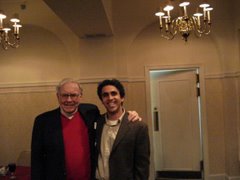
The ultimate question people often desire to know of investors or investment funds is what makes them so special or uniquely qualified to outperform the market. The investing landscape has changed dramatically over the past 60 years. Back in the 1950's, a young man by the name of Warren Buffett found his edge by essentially being one in a handful of people that truly applied statistical analysis in a market dominated by investment activity that focused its attention on the most commonly known stocks. Add to that a dose of market inefficiency that does not exist today due to the sheer number of market participants, and Buffett found himself in a money making playground.
Nevertheless, Buffett was different than his mentor Ben Graham. While no one will question Graham's paramount influence on the success of Warren Buffett (not even the man himself), Buffett took the tools and built his own foundation. Buffett is indeed a value investor, but a unique one. Reading over his partnership letters, one can clearly see how Buffett developed his own style - his edge.
Buffett's first edge was his classification of the three areas his participated in - workouts, generally undervalued, and arbitrage. But over time, his edge developed into other areas - control situations, buyouts, etc. Then he moved on to insurance, with gave him the edge of extremely low cost capital. In other words, Buffett created his own form of leverage. The rest is history. As Berkshire grew, so too did Buffett's approach to investing, dictated not by a deviation from his root principles of value, but via the need to properly allocate capital.
Thus the key to successful investing is to develop an edge, but more importantly an edge than you can truly exploit in all environments. Occasionally investors will get thrown a year like 2009, when you can very easily find excellent business trading at substantial discounts to net current assets, P/E ratios of less than 4, or a ridiculous fraction of undervalued book value. In times like these, all one needs is to be ready to act quickly and decisively, and then sit still.
However, during the 80% of the market time when prices are fairly valued at best, a clearly defined investment edge can set one apart. Indeed, value investing, practiced in its true form, is in itself a tremendous edge. The ability to buy unloved businesses or companies currently experiencing temporary problems is not something that relatively many investors can really do. The ability to do nothing while markets are very active is another tremendous edge.
Nevertheless, 2008 showed how just about any approach to investing can suffer a setback. Indeed, while many who were fortunate enough to stick around after 2008 got a chance at retribution in 2009, I continue to refine my investment approach from the experiences of 2008. Like many value funds, we underperformed in 2008. And like many, we vastly outperformed in 2009. Even so, the thinking at Gad Capital has evolved.
Make no mistake, as I outline in my book The Business of Value Investing, my approach still firmly has its roots in six steps I outline in making successful investments:
1. Have a sound investment philosophy
2. Develop a good search strategy
3. Learn to value a business and assess the quality of management
4. Have the discipline to say no
5. Be Patient
6. Have the courage to make a significant investment at maximum point of pessimism.
The order above is deliberate. You can do #3 without #2, and so on.
However, seeing as my fund is relatively small in the investment field, I spend a significant amount of time looking where others simply can not look due to sheer size. For example, this year, we were still able to invest in a sub $10 million company with over twice its market cap in cash and no debt. As one of my potential investment partners told me last year at a meeting, "If the goal in investing is to make money, which is determined by investment returns, it seems to me that having a smaller sum of initial capital makes more sense in generating those returns." There's tremendous wisdom in that comment. Far few funds truly exploit the asymmetrical edge available when working with smaller sums. I know spend a bit more time exploiting this asymmetry.
The other component, and one I have come to realize that I've underappreciated significantly, is the tremendous edge one gets when investing alongside quality management. By this, it's no longer enough for me that a CEO owns 10% of the company or travels coach instead of first class (although I value such alignment of interest immensely). Instead, I become very excited when I see extremely unusual behavior from management. For example, when a CEO of a company decides to borrow money to pay off his divorce settlement so he doesn't have to sell a single share of stock to raise money (true story), that grabs my attention. When a CEO flies across the country to buy a tiny business for $100,000 that is earning $50,000 in net profit, that grabs my attention.
When a CEO decides to stop bidding on contracts to let his competitors take the bids because margins are exceedingly low or negative, that grabs my attention. In essence, this CEO is essentially doing something that will cause his share price to go down in short run, but does so because he knows that in the long run, his firm will be around to take the lion's share of projects when margins are again attractive.
Management that behaves in such extraordinary ways usually produces extraordinary businesses in the long run. Such businesses can and should be held during any market environment. In essence, finding management of this type is like finding the best value investor in that industry. So yes, focusing on quality management is nothing new, but I'd argue that how to really examine management is not often done by many.
Sunday, March 21, 2010


Wednesday, February 17, 2010
Conservative Investing is Successful Investing
Mention conservative investing and what you often get are people who think that conservative investing means putting money away in the biggest, most stable enterprises which in turn guarantees safety of principal. If the invested capital happens to also appreciate in value, then even the better. But if not, at least being conservative helps one sleep better at night. That may indeed be true, but unless you're ready to ignore inflation, many investors have it backwards when it comes to conservative investing.
While it’s indeed true that enterprises like utilities are defined as conservative, simply buying the large, well known companies does not fulfill the goal of a successful conservative investment approach. Instead, such a viewpoint increases the confusion between acting conservatively and behaving conventionally.
Two Definitions
Conservative investing, when understood and applied properly, is not a low risk low return strategy. Investors must understand two definitions to appreciate the appropriate means by which to invest conservatively.
1. A conservative investment is one which carries the greatest likelihood of preserving the purchasing power of one’s capital with the least amount of risk.
2. Conservative investing is first, the understanding of a conservative investment is, and second, following a specific course of action needed to properly determine whether or not particular investments are indeed conservative investments.
Where many investors falter in attempting to invest conservatively is blindly assuming that by purchasing any security that qualifies as a conservative investment, they are in fact, conservative investors. In other words, such investors simply focus on the first definition.
Such a viewpoint is limited and costly. A successful conservative investment approach requires not only an understanding of what a conservative investment is, but more importantly the correct approach to take in order to identify what truly qualifies as a conservative investment.
Characteristics of Conservative Investment
If based on the first definition, investors already know what qualifies as a conservative investment, then one needs to know what characteristics define a conservative investment which is where the second definition comes into play. There are four broad categories with investors can use to identify a conservative investment.
1. The Safety Factor
Clearly any conservative investment should be able weather market storms better than most. In other to do this, certain characteristics stand out. First, a business should have a low cost of production. Being a low cost producer has the principle advantage that when a bad year hits the industry, the low cost producer has best chance of still churning out a profit or reporting a smaller net loss. Second, a business should have a strong research and marketing department. A company that can not compete by staying abreast of market changes and trends is doomed in the long run. Finally, management should possess financial skill as in doing so they will be well versed in things like per unit cost of production, maximizing return on invested in capital, and other essential elements of business success.
2. The People Factor
This is a rather self-explanatory qualification for a conservative investment. But take notice that excellent people can only be beneficial after a business has demonstrated the signs of quality above. Take note of Warren Buffett’s advice:
“When a management team with a reputation for brilliance tackles a business with a reputation for bad economics, it is the reputation of the business that remains intact.”
A small company can succeed on the heels of one or two exceptionally talented people. But as a business grows, people throughout the organization must be counted if the company is to succeed and remain a conservative investment.
3. Business Characteristics
This third quality requires a little more work for investors but its well worth the effort. Here, the goal for investors is to determine what advantages or disadvantages may prevent the business from growing and earning more profits despite satisfying the first two conditions. Things to consider are the competitive landscape of the business. The existence of many competitors or the relative ease with which new competition can enter can affect the best of companies. The potential for excessive regulation could also be a game changer.
In essence, remember that just because a company satisfies the obvious conditions of being a conservative investment always remember to consider this third condition. The following examples will illustrate this concept further.
Those Who Fail and Those Who Pass
Great examples of those businesses that pass the test include names like Coca-Cola, Wal-Mart and Johnson and Johnson. These companies have demonstrated time and time again the strength of their franchises. Even more importantly, both of these companies will likely continue to have very favorable future prospects. Coke essentially competes with Pepsi and Dr. Pepper and no one else. More so, it’s unlikely that entrepreneurs are sitting in garages thinking about creating the next great soft drink company.
Because Wal-Mart exists and succeeds, that should raise a red flag for most other retailers, save for Target and a few specailty retailers. Remember Circuit City, which used to be number 2 to Best Buy in electronic retailing? It’s now bankrupt in no small part due to Wal-Mart. Toys ‘R’ Us was taken out in a private transaction a few years ago due to various competitive threats which likely included Wal-Mart's expansion of its toy department.
Of course once a passing company has been identified, the stock price matters only inasmuch as to determine the value gained. Today, names that pass and trade at very attractive prices include Kraft Foods, Pfizer, and Vodafone.
A Collective Approach
Investing conservatively is not about simply identifying large well-known businesses, but going through a process that identifies why a particular company qualifies as a conservative investment. And as you can see from the names above, being an conservative investor can lead to some of most dependable and respectable returns in the market.
While it’s indeed true that enterprises like utilities are defined as conservative, simply buying the large, well known companies does not fulfill the goal of a successful conservative investment approach. Instead, such a viewpoint increases the confusion between acting conservatively and behaving conventionally.
Two Definitions
Conservative investing, when understood and applied properly, is not a low risk low return strategy. Investors must understand two definitions to appreciate the appropriate means by which to invest conservatively.
1. A conservative investment is one which carries the greatest likelihood of preserving the purchasing power of one’s capital with the least amount of risk.
2. Conservative investing is first, the understanding of a conservative investment is, and second, following a specific course of action needed to properly determine whether or not particular investments are indeed conservative investments.
Where many investors falter in attempting to invest conservatively is blindly assuming that by purchasing any security that qualifies as a conservative investment, they are in fact, conservative investors. In other words, such investors simply focus on the first definition.
Such a viewpoint is limited and costly. A successful conservative investment approach requires not only an understanding of what a conservative investment is, but more importantly the correct approach to take in order to identify what truly qualifies as a conservative investment.
Characteristics of Conservative Investment
If based on the first definition, investors already know what qualifies as a conservative investment, then one needs to know what characteristics define a conservative investment which is where the second definition comes into play. There are four broad categories with investors can use to identify a conservative investment.
1. The Safety Factor
Clearly any conservative investment should be able weather market storms better than most. In other to do this, certain characteristics stand out. First, a business should have a low cost of production. Being a low cost producer has the principle advantage that when a bad year hits the industry, the low cost producer has best chance of still churning out a profit or reporting a smaller net loss. Second, a business should have a strong research and marketing department. A company that can not compete by staying abreast of market changes and trends is doomed in the long run. Finally, management should possess financial skill as in doing so they will be well versed in things like per unit cost of production, maximizing return on invested in capital, and other essential elements of business success.
2. The People Factor
This is a rather self-explanatory qualification for a conservative investment. But take notice that excellent people can only be beneficial after a business has demonstrated the signs of quality above. Take note of Warren Buffett’s advice:
“When a management team with a reputation for brilliance tackles a business with a reputation for bad economics, it is the reputation of the business that remains intact.”
A small company can succeed on the heels of one or two exceptionally talented people. But as a business grows, people throughout the organization must be counted if the company is to succeed and remain a conservative investment.
3. Business Characteristics
This third quality requires a little more work for investors but its well worth the effort. Here, the goal for investors is to determine what advantages or disadvantages may prevent the business from growing and earning more profits despite satisfying the first two conditions. Things to consider are the competitive landscape of the business. The existence of many competitors or the relative ease with which new competition can enter can affect the best of companies. The potential for excessive regulation could also be a game changer.
In essence, remember that just because a company satisfies the obvious conditions of being a conservative investment always remember to consider this third condition. The following examples will illustrate this concept further.
Those Who Fail and Those Who Pass
Great examples of those businesses that pass the test include names like Coca-Cola, Wal-Mart and Johnson and Johnson. These companies have demonstrated time and time again the strength of their franchises. Even more importantly, both of these companies will likely continue to have very favorable future prospects. Coke essentially competes with Pepsi and Dr. Pepper and no one else. More so, it’s unlikely that entrepreneurs are sitting in garages thinking about creating the next great soft drink company.
Because Wal-Mart exists and succeeds, that should raise a red flag for most other retailers, save for Target and a few specailty retailers. Remember Circuit City, which used to be number 2 to Best Buy in electronic retailing? It’s now bankrupt in no small part due to Wal-Mart. Toys ‘R’ Us was taken out in a private transaction a few years ago due to various competitive threats which likely included Wal-Mart's expansion of its toy department.
Of course once a passing company has been identified, the stock price matters only inasmuch as to determine the value gained. Today, names that pass and trade at very attractive prices include Kraft Foods, Pfizer, and Vodafone.
A Collective Approach
Investing conservatively is not about simply identifying large well-known businesses, but going through a process that identifies why a particular company qualifies as a conservative investment. And as you can see from the names above, being an conservative investor can lead to some of most dependable and respectable returns in the market.
Friday, January 15, 2010
Understanding Profits Leads to Better Investment Decision Making
After 2009’s eye popping market performance, investors need to take a moment and consider what really matters when pouring over company financial reports and earnings statements. It ain't net earnings, although to the detriment of many investors, it's the metric they hinge on. Instead its the one metric that supercedes all others, save for maybe the quality of management. That metric is cash flow.
Investors would be very well served to instead pay attention to cash flows first and foremost. While it’s widely known that earnings can be massaged, investors should be aware that not all attempts to manicure earnings are illegal. Management can legitimately make corporate decisions that have a direct effect on the level of reported earnings.
The most significant decision is the use of depreciation to influence earnings. When a business purchases property, plant, or equipment, it is entitled to depreciate that asset. A growing business will likely have capital expenditures that are significantly above depreciation levels. Such a difference is acceptable for a period of time. And cyclical businesses will likely have periods where cap ex goes up dramatically as they make upgrades or new investments.
However, whenever prolonged periods where depreciation is significantly below cap ex or the other way around, investors should take note. Such discrepancies paint an inaccurate picture of earnings, which demands that investors always examine the cash flows along with earnings. When cap ex consistently exceeds depreciation, then true earnings are actually lower than those reported on the income statement. Conversely, when depreciation exceeds cap ex, then the earnings are better than they appear.
And it’s for the above reasons that value investors typically shun away from capital intensive businesses that earn low returns on invested capital. That’s why Buffett’s deal for railroad Burlington Northern has many scratching their heads. While I’m not investing in any railroads, remember that Buffett’s advantage is the fact that he will own 100% of the business plus the likelihood that Berkshire will own it for decades, which is the only possible way he will get the value he often demands (which coincidentally happens to be pretty darn attractive for the sum of money he is putting up). People often neglect little things like the fact that Burlington’s $470 million or so in annual dividends will now go to Buffett
A good understaning of earnings in relation to cash flows will present the real performance picture.
Investors would be very well served to instead pay attention to cash flows first and foremost. While it’s widely known that earnings can be massaged, investors should be aware that not all attempts to manicure earnings are illegal. Management can legitimately make corporate decisions that have a direct effect on the level of reported earnings.
The most significant decision is the use of depreciation to influence earnings. When a business purchases property, plant, or equipment, it is entitled to depreciate that asset. A growing business will likely have capital expenditures that are significantly above depreciation levels. Such a difference is acceptable for a period of time. And cyclical businesses will likely have periods where cap ex goes up dramatically as they make upgrades or new investments.
However, whenever prolonged periods where depreciation is significantly below cap ex or the other way around, investors should take note. Such discrepancies paint an inaccurate picture of earnings, which demands that investors always examine the cash flows along with earnings. When cap ex consistently exceeds depreciation, then true earnings are actually lower than those reported on the income statement. Conversely, when depreciation exceeds cap ex, then the earnings are better than they appear.
And it’s for the above reasons that value investors typically shun away from capital intensive businesses that earn low returns on invested capital. That’s why Buffett’s deal for railroad Burlington Northern has many scratching their heads. While I’m not investing in any railroads, remember that Buffett’s advantage is the fact that he will own 100% of the business plus the likelihood that Berkshire will own it for decades, which is the only possible way he will get the value he often demands (which coincidentally happens to be pretty darn attractive for the sum of money he is putting up). People often neglect little things like the fact that Burlington’s $470 million or so in annual dividends will now go to Buffett
A good understaning of earnings in relation to cash flows will present the real performance picture.
Tuesday, October 13, 2009
Where "Value" Investors Often Go Wrong
After what happened to equity markets in 2008, many financial "experts" began to question whether or not any investing school of thought really worked. Those who believed that the market was efficient found egg on their face when all was said and done. I didn't need 2008 to prove to me that markets were inefficient. The proof positive reason I have for market inefficiency is simple this: the stock market consists of human participants who by their very nature are irrational and inefficient creatures.
The other school of thought that took a beating was that of value investing. I've never really been fond of using the term value investing, since I subscribe to the Charlie Munger view that "all investing is value investing." Further I believe that the value and growth aspects of investing are merely two sides of the same coin. Nonetheless, its because precisely that so few individuals actually subscribe to the tenants of value investing (those being risk aversion, avoidance of crowd psychology, buying businesses in out in favor places, etc.) that we do use the term value investing. So it is in this context that I dispense of the term value investing and how I adhere to it.
Let me use a moment now to throw in a shameless plug for my recent book that was just published by John Wiley and Sons, "The Business of Value Investing" which focuses on precisely how a businesslike mind frame is what true value investors employ in selecting equities. The book focuses on the six essential elements (use of the word element is deliberate - elements are essential to life) that are incorporated in the value investors mind.
Back to the topic at hand. Value investing was left for dead after 2008. I mean when Bill Miller nearly 50% in a year and Mohnish Pabrai drops by nearly 60%, surely the approach is flawed. Never mind that folks criticizing the tenets of value are dismissing over 80 years of results by Ben Graham, Walter Schloss, Warren Buffett, and Seth Klarman. Even I will admit the Gad Partners Funds' had a terrible 2008, down nearly 45 percent. But the value investor sticks to his knitting, obviously willing to tweak his or her approach, but never doubting the inherent success of the foundations of value investing. (By the way, I believe Miller is up nearly 50% this year and Pabrai is up over 100%. As for the GPF, I can't get into the specifics but we are in between Miller and Pabrai. Obviously simple tells you that even those results have yet to get any of us back above 2008 levels, but we are not done, not by a long shot.)
Where many "value" folk go wrong is in a very fundamental sense. Many investors spend far too much time focusing on the income statement first and the balance sheet second. No question, profits are important, but without a solid foundation, those profits are only as good as the business environment. And no business environment stays rosy forever - there are hiccups. And if business setbacks are hiccups, 2008 was a trip to the ICU.
The balance sheet must always be the most relied upon piece of information. In basic value terminology, the balance sheet is the FIRST MOAT. Of course, the balance sheet alone is not enough. The income statement is the SECOND MOAT. A debt free, cash rich company is great, but not so great if that business can't produce profits. Still a profitless company with a sound balance sheet still has value creating catalysts - buyout, liquidation, etc. - that serve to protect the investor. The same is not true for a profitless company loaded with debt or poor assets. The results here can often be massive shareholder dilution in order to keep the company afloat or worse, bankruptcy.
The other school of thought that took a beating was that of value investing. I've never really been fond of using the term value investing, since I subscribe to the Charlie Munger view that "all investing is value investing." Further I believe that the value and growth aspects of investing are merely two sides of the same coin. Nonetheless, its because precisely that so few individuals actually subscribe to the tenants of value investing (those being risk aversion, avoidance of crowd psychology, buying businesses in out in favor places, etc.) that we do use the term value investing. So it is in this context that I dispense of the term value investing and how I adhere to it.
Let me use a moment now to throw in a shameless plug for my recent book that was just published by John Wiley and Sons, "The Business of Value Investing" which focuses on precisely how a businesslike mind frame is what true value investors employ in selecting equities. The book focuses on the six essential elements (use of the word element is deliberate - elements are essential to life) that are incorporated in the value investors mind.
Back to the topic at hand. Value investing was left for dead after 2008. I mean when Bill Miller nearly 50% in a year and Mohnish Pabrai drops by nearly 60%, surely the approach is flawed. Never mind that folks criticizing the tenets of value are dismissing over 80 years of results by Ben Graham, Walter Schloss, Warren Buffett, and Seth Klarman. Even I will admit the Gad Partners Funds' had a terrible 2008, down nearly 45 percent. But the value investor sticks to his knitting, obviously willing to tweak his or her approach, but never doubting the inherent success of the foundations of value investing. (By the way, I believe Miller is up nearly 50% this year and Pabrai is up over 100%. As for the GPF, I can't get into the specifics but we are in between Miller and Pabrai. Obviously simple tells you that even those results have yet to get any of us back above 2008 levels, but we are not done, not by a long shot.)
Where many "value" folk go wrong is in a very fundamental sense. Many investors spend far too much time focusing on the income statement first and the balance sheet second. No question, profits are important, but without a solid foundation, those profits are only as good as the business environment. And no business environment stays rosy forever - there are hiccups. And if business setbacks are hiccups, 2008 was a trip to the ICU.
The balance sheet must always be the most relied upon piece of information. In basic value terminology, the balance sheet is the FIRST MOAT. Of course, the balance sheet alone is not enough. The income statement is the SECOND MOAT. A debt free, cash rich company is great, but not so great if that business can't produce profits. Still a profitless company with a sound balance sheet still has value creating catalysts - buyout, liquidation, etc. - that serve to protect the investor. The same is not true for a profitless company loaded with debt or poor assets. The results here can often be massive shareholder dilution in order to keep the company afloat or worse, bankruptcy.
Thursday, September 17, 2009
Thursday, September 10, 2009
Macro Matters
Despite the often perceived notion that adherents of value investing ignore the macro economy, nothing could be further from the truth. Make no mistake: the central tenant of value investing is to buy assets at a significant discount to thier intrinsic value, where such an intrinsic value is typically determined by the cash generation of those assets.
The problem to those outside the value circle looking in is that value investors often make such investments during the most pessimistic market environments, which almost always means that the stock price will fall some more once it is purchases. This leads many to believe that a value oriented approach ignores macro economic considerations.
Such beliefs are myths and if you look at the approaches of the most successful value investors, consideration is always given to certain macro economic factors. Understanding this delicate distinction will prove very fruitful to investors going forward in making investment decisions.
If there is anything that trumps all other considerations to a value investor, it’s the price paid for a security. In many cases, a fire-sale price can be overcome by macro considerations. For example, consider the restaurant industry. For many reasons, many restaurants aside from ultra budget friendly places are relatively unattractive investment candidates to many value investors. Restaurants are often characterized by thin profit margins, extremely low barriers to entry, and the availability of numerous substitutes.
But what is also considered are things like the rate of unemployment, the household savings rate, and consumer spending. You might not see this in the value investor's analysis of the company per se, but they are all seriously considered in any worthwhile analysis.
Nonetheless, where the value investor hinges his ultimate bet on is the price paid for the security.
The Future for Investors
So looking ahead, what doest this mean for investors? It means that just because a stock has a P/E of 8, it might not represent a bargain when you consider the macro environment going forward. As noted investment manager Jeremy Grantham remarked recently after the recent market rally, it appears the market is headed for “seven lean years.”
But it also means that value can be ascertained in various forms. For mental stimulation, consider the following example:
For instance at P/E of 20, many value "wannabes" may be quick to dismiss Hutchison Telecom International a company that provides mobile and fixed line telecommunications services in the Asia-Pacific region, specifically in areas like Indonesia, Vietnam, and Thailand. You’re essentially getting a company with a huge option on increased telecommunications use from the world’s fastest growing region.
Hutchison used to be a huge amalgamation of telecom businesses throughout the emerging world. However, the company recently spun-off the Hong Kong and Macau operations into Hutchison Telecommunications. HTX is now the more “volatile” growth targeting emerging markets provider. Even after the spin-off Hutchison Telecom owned 51% of Partner Communications the number 2 telecom based in Israel. Subsequently the stake was put up for sale for $1.38 billion
Quickly looking at Partner, Hutchison Telecom may seem like an absurd bargain. Hutchison currently has an enterprise value of some $1.5 billion, while the 51% stake in Partner is will fetch HTX $1.4 billion. This might seem that investors are getting to bet on telecommunications growth in Indonesia, Veitnam, and Sri Lanka for free. Unfortunately, the market is already aware of about $900 million in cap ex that Hutchison is planning for expansion into the emerging countries. Still, if any of those emerging countries do as well as India or China in terms of penetration, there’s huge upside.
So Hutchison offers a very interesting play in the fastest growing region in the world. Underlying this thought is a favorable long-term macro view: as a country develops its citizens will need communication capabilities.
If you train yourself to look at a company in such a fashion, you begin to understand what matters most when looking at a business.
Put the Process Before the Outcome
Value investing works if pursued patiently and meticulously. The goal is to always seek out market mis-pricings because when you can, the margin of safety protects you from sudden or temporary shifts in the macro-economic environment. But that doesn’t mean value investors ignore the macro economy, instead it’s always factored into a thorough and quality analytical framework.
The problem to those outside the value circle looking in is that value investors often make such investments during the most pessimistic market environments, which almost always means that the stock price will fall some more once it is purchases. This leads many to believe that a value oriented approach ignores macro economic considerations.
Such beliefs are myths and if you look at the approaches of the most successful value investors, consideration is always given to certain macro economic factors. Understanding this delicate distinction will prove very fruitful to investors going forward in making investment decisions.
If there is anything that trumps all other considerations to a value investor, it’s the price paid for a security. In many cases, a fire-sale price can be overcome by macro considerations. For example, consider the restaurant industry. For many reasons, many restaurants aside from ultra budget friendly places are relatively unattractive investment candidates to many value investors. Restaurants are often characterized by thin profit margins, extremely low barriers to entry, and the availability of numerous substitutes.
But what is also considered are things like the rate of unemployment, the household savings rate, and consumer spending. You might not see this in the value investor's analysis of the company per se, but they are all seriously considered in any worthwhile analysis.
Nonetheless, where the value investor hinges his ultimate bet on is the price paid for the security.
The Future for Investors
So looking ahead, what doest this mean for investors? It means that just because a stock has a P/E of 8, it might not represent a bargain when you consider the macro environment going forward. As noted investment manager Jeremy Grantham remarked recently after the recent market rally, it appears the market is headed for “seven lean years.”
But it also means that value can be ascertained in various forms. For mental stimulation, consider the following example:
For instance at P/E of 20, many value "wannabes" may be quick to dismiss Hutchison Telecom International a company that provides mobile and fixed line telecommunications services in the Asia-Pacific region, specifically in areas like Indonesia, Vietnam, and Thailand. You’re essentially getting a company with a huge option on increased telecommunications use from the world’s fastest growing region.
Hutchison used to be a huge amalgamation of telecom businesses throughout the emerging world. However, the company recently spun-off the Hong Kong and Macau operations into Hutchison Telecommunications. HTX is now the more “volatile” growth targeting emerging markets provider. Even after the spin-off Hutchison Telecom owned 51% of Partner Communications the number 2 telecom based in Israel. Subsequently the stake was put up for sale for $1.38 billion
Quickly looking at Partner, Hutchison Telecom may seem like an absurd bargain. Hutchison currently has an enterprise value of some $1.5 billion, while the 51% stake in Partner is will fetch HTX $1.4 billion. This might seem that investors are getting to bet on telecommunications growth in Indonesia, Veitnam, and Sri Lanka for free. Unfortunately, the market is already aware of about $900 million in cap ex that Hutchison is planning for expansion into the emerging countries. Still, if any of those emerging countries do as well as India or China in terms of penetration, there’s huge upside.
So Hutchison offers a very interesting play in the fastest growing region in the world. Underlying this thought is a favorable long-term macro view: as a country develops its citizens will need communication capabilities.
If you train yourself to look at a company in such a fashion, you begin to understand what matters most when looking at a business.
Put the Process Before the Outcome
Value investing works if pursued patiently and meticulously. The goal is to always seek out market mis-pricings because when you can, the margin of safety protects you from sudden or temporary shifts in the macro-economic environment. But that doesn’t mean value investors ignore the macro economy, instead it’s always factored into a thorough and quality analytical framework.
Tuesday, April 28, 2009
Invest Like It's The End of the World and Be Rewarded
It's been nearly four months since I last posted - it's always about quality not quantity, eh? Needless to say, I've been - and happily so - swamped with reading annual reports and finishing up my first book, due out in October. Nonetheless, with investors of all stripes turning thier heads looking for answers, I'm here to say I don't have any. But I do have some thoughts on what seems to be a prudent approach to our craft.
I have a lot of respect for Ian Cumming and Joe Steinberg, the top brass at Leucadia. Like everyone else, they had a dismal 2008. Many of Leucadia's investments - commodities, real estate, wineries - are simply dependant on the economy turning around. But one year a track record doesn't make. But 30 or so years it does and Leucadia's results over that time have been off the charts: book value per share has increased at a 17.3 compounded annual growth rate from 1979 - 2008.
So naturally, I enjoy reading the company’s annual letter to shareholders for any nuggets of wisdom or investment ideas since Leucadia is nothing more than a conglomerate of investment holdings. Reading Leucadia's annual letter over the weekend, I was intrigued by Cummings and Steinberg's assessment of the future.
"Out of prudence we have a pessimistic view as to when this recession will end. To think otherwise would be to gamble about the beginnings of good times whereas by imagining a bleak future we will most likely survive for the good times to arrive."
So naturally, I enjoy reading the company’s annual letter to shareholders for any nuggets of wisdom or investment ideas since Leucadia is nothing more than a conglomerate of investment holdings. Reading Leucadia's annual letter over the weekend, I was intrigued by Cummings and Steinberg's assessment of the future.
"Out of prudence we have a pessimistic view as to when this recession will end. To think otherwise would be to gamble about the beginnings of good times whereas by imagining a bleak future we will most likely survive for the good times to arrive."
I find the above statement to be one of the greatest pieces of investment wisdom I've come across recently. Investors would be well served to take the above assessment and apply it to their investments going forward. I like to call it an “invest for the worst and hope for the best” kind of approach to investing today.
My approach stems from the fact that investors are crazy if they are analyzing most businesses based on 2007 profits/multiples. Don't get me wrong: we could very well be easily sitting in the midst of the greatest buying opportunities of a lifetime. Indeed, I lean towards this view. However, it's with prudence that investors must assume that the market will remain in a funk in order to profit handsomely when spring does come. Because if you assume the worst, your investment process, by default, will become much more skeptical. All investors should arm themselves with a healthy does of skepticism at all times.
The wonderful thing about 45% market declines is that many stocks fall a lot a harder, thus setting the setting for phenomenal returns. Forget the preverbial 50 cent dollar - they are a dime a dozen today. Thirty cent - even ten cent dollars - can be found today with a little extra effort.
True value investors are not afraid to pounce if a security is widely undervalued. They time stock prices and not stock markets. In a recent interview Buffett said he would relish the opportunity to be in his 20's all over again today.
We're certainly not out of the woods yet, and it seems that it really won't be until 2011 until the economy recovers again. But it's a guessing game as to when the stock market will turn - they are forward looking creatures after all. But then again, value investors aren't timing stock markets.
Monday, January 5, 2009
What Really Matters In Investing
Why Prudent Investors Focus on Holding Period Returns
With 2008 finally over, many investors have equity portfolios that have shriveled by 30% to 70%. Simple arithmetic will tell you that if you're down 50% in 2008, you need a 100% return to get back to even. While possible, it will be a remote possibility for many to earn a triple digit return in 2009 considering that many consider it to be a healing year at best.
Whether we like it or not, investing is most beneficial and pays off when done for a period of many years. As such, investors holding securities are better off focusing on holding period returns, which is what really matters. The stock market swings wildly in the short run, but over time, stock prices have always caught up with the underlying fundamentals of the business. Skeptics will correctly argue that investing a dollar invested in the market over the past decade would be worth slightly less today. But I’m not talking about investing in the broad market, but instead individual securities.
One thousand dollars invested in steel producer Nucor would be worth about $20,000 at the end of 2008. The same $1,000 invested in UnitedHealth Group in 1998 would be worth over $15,000 today once you factor in three 2 for 1 stock splits that occurred in 2000, 2003, and 2005. Even boring old Wal-Mart shares would have been worth about $3,000 today in exchange for putting up $1,000 in 1998, and this is not including the dividend. And even and investment in 1998 in Whole Foods which today trades around $9 share, down from an all-time high of $80, would be up over twofold when accounting for the two stock splits.
The market is tough to beat, but you could have easily made satisfactory returns over the past ten years in which the market went nowhere. And these returns would have outperformed real estate, bonds, and just about any other asset class.
The next decade will be no different even if you started in 2008 and can muster the courage and patience to keep going. No one has a clue what the market performance over the next five and ten years will be. But everyone will agree that there will be many companies that will be bigger, better, and more profitable. And Mr. Market doesn’t care about fundamentals in 2008, businesses that continue to improve profit generation will ultimately be recognized.
History Doesn’t Repeat Itself...But It Does Rhyme
Knowing a little market history after the worst year since the Depression can be very instructive. The following chart shows how the Dow has fared during and after recessions.
Recessionary Period (Change in Dow during recession) (Change one year after)
Aug 1929 - March 1933 (-84.2%) (81.1% )
May 1937 - June 1938 (-23.2%) (-2.4%)
Feb 1945 - Oct 1945 (21.3%) (-9.4%)
Nov 1948 - Oct 1949 (-0.12%) (18.7%)
July 1953 - May 1954 (21.6%) (29.7%)
Aug 1957 - April 1958 (-9.9%) (36.8%)
April 1960 - Feb 1961 (7.5%) (6.9%)
Dec 1969 - Nov 1970 (-1.4%) (4.7%)
Nov 1973 - March 1975 (-19.0%) (30.1%)
Jan 1980 - July 1980 (11.5%) (1.9%)
July 1981 - Nov 1982 (7.4%) (22.8%)
July 1990 - March 1991 (1.2%) (11.0%)
Mar 2001 - Nov 2001 (-5.7%) (-9.7%)
The crucial part, of course, is how long our current recession will affect the market. No one truly knows. What we do know is that the market will have turned by the time we get the “official” word.
But another important chart to look at is below.
Company [2001 Price] [2003 Price] [2007 Price]
Apple [$7-$13] [$6 - $12] [$82 - $200]
Vulcan Materials [$37 - $55] [$29 -$49] [$77 - $129]
Tesoro Corp [$5 - $8] [$2 - $7] [$31 - $66]
Transocean [$23 - $57] [$18 -$26] [$73 - $150]
Fluor [$15 -$31] [$10 - $22] [$37 - $86]
Source: Value Line (note: prices reflected low’s and highs for the year are rounded to nearest dollar for illustrative purposes)
The sample above is instructive in showing us how markets behave. Many securities that were bought in 2001 - a year of double digit market declines - were deeply underwater at the end of the year. Two years later many investors were still down by over 50% on many holdings if they had held on. But by 2007, if you had invested in solid companies with great earnings power, you more than made up for it. Even with a 60% two year decline in share value for Fluor shares in the heavy construction firm more than rewarded long-term investors. Assuming you had bought at $25 in 2001, you were down over 50% by 2003. Assuming you had sold at $65 in 2007, your six year holding period return was $160%. I’ll take numbers like that all day.
This recession is vastly worse than the 2001 variety. But as a long-term investor, you should keep your focus on holding period returns and if you stick with businesses that will be doing well a couple of years from now, you’ll realize that stocks can still produce the best returns.
With 2008 finally over, many investors have equity portfolios that have shriveled by 30% to 70%. Simple arithmetic will tell you that if you're down 50% in 2008, you need a 100% return to get back to even. While possible, it will be a remote possibility for many to earn a triple digit return in 2009 considering that many consider it to be a healing year at best.
Whether we like it or not, investing is most beneficial and pays off when done for a period of many years. As such, investors holding securities are better off focusing on holding period returns, which is what really matters. The stock market swings wildly in the short run, but over time, stock prices have always caught up with the underlying fundamentals of the business. Skeptics will correctly argue that investing a dollar invested in the market over the past decade would be worth slightly less today. But I’m not talking about investing in the broad market, but instead individual securities.
One thousand dollars invested in steel producer Nucor would be worth about $20,000 at the end of 2008. The same $1,000 invested in UnitedHealth Group in 1998 would be worth over $15,000 today once you factor in three 2 for 1 stock splits that occurred in 2000, 2003, and 2005. Even boring old Wal-Mart shares would have been worth about $3,000 today in exchange for putting up $1,000 in 1998, and this is not including the dividend. And even and investment in 1998 in Whole Foods which today trades around $9 share, down from an all-time high of $80, would be up over twofold when accounting for the two stock splits.
The market is tough to beat, but you could have easily made satisfactory returns over the past ten years in which the market went nowhere. And these returns would have outperformed real estate, bonds, and just about any other asset class.
The next decade will be no different even if you started in 2008 and can muster the courage and patience to keep going. No one has a clue what the market performance over the next five and ten years will be. But everyone will agree that there will be many companies that will be bigger, better, and more profitable. And Mr. Market doesn’t care about fundamentals in 2008, businesses that continue to improve profit generation will ultimately be recognized.
History Doesn’t Repeat Itself...But It Does Rhyme
Knowing a little market history after the worst year since the Depression can be very instructive. The following chart shows how the Dow has fared during and after recessions.
Recessionary Period (Change in Dow during recession) (Change one year after)
Aug 1929 - March 1933 (-84.2%) (81.1% )
May 1937 - June 1938 (-23.2%) (-2.4%)
Feb 1945 - Oct 1945 (21.3%) (-9.4%)
Nov 1948 - Oct 1949 (-0.12%) (18.7%)
July 1953 - May 1954 (21.6%) (29.7%)
Aug 1957 - April 1958 (-9.9%) (36.8%)
April 1960 - Feb 1961 (7.5%) (6.9%)
Dec 1969 - Nov 1970 (-1.4%) (4.7%)
Nov 1973 - March 1975 (-19.0%) (30.1%)
Jan 1980 - July 1980 (11.5%) (1.9%)
July 1981 - Nov 1982 (7.4%) (22.8%)
July 1990 - March 1991 (1.2%) (11.0%)
Mar 2001 - Nov 2001 (-5.7%) (-9.7%)
The crucial part, of course, is how long our current recession will affect the market. No one truly knows. What we do know is that the market will have turned by the time we get the “official” word.
But another important chart to look at is below.
Company [2001 Price] [2003 Price] [2007 Price]
Apple [$7-$13] [$6 - $12] [$82 - $200]
Vulcan Materials [$37 - $55] [$29 -$49] [$77 - $129]
Tesoro Corp [$5 - $8] [$2 - $7] [$31 - $66]
Transocean [$23 - $57] [$18 -$26] [$73 - $150]
Fluor [$15 -$31] [$10 - $22] [$37 - $86]
Source: Value Line (note: prices reflected low’s and highs for the year are rounded to nearest dollar for illustrative purposes)
The sample above is instructive in showing us how markets behave. Many securities that were bought in 2001 - a year of double digit market declines - were deeply underwater at the end of the year. Two years later many investors were still down by over 50% on many holdings if they had held on. But by 2007, if you had invested in solid companies with great earnings power, you more than made up for it. Even with a 60% two year decline in share value for Fluor shares in the heavy construction firm more than rewarded long-term investors. Assuming you had bought at $25 in 2001, you were down over 50% by 2003. Assuming you had sold at $65 in 2007, your six year holding period return was $160%. I’ll take numbers like that all day.
This recession is vastly worse than the 2001 variety. But as a long-term investor, you should keep your focus on holding period returns and if you stick with businesses that will be doing well a couple of years from now, you’ll realize that stocks can still produce the best returns.
Wednesday, December 3, 2008
Mueller Water Arbitrage: Taking Candy from a Baby
Mueller Water Products (NYSE: MWA & MWA-B) was spun out of Walter Industries in 2006. Prior to the spin-off Mueller’s Class A shares were already trading in the market via an IPO. Subsequent to the spin-off Mueller issued Class B shares to the existing shareholders of Walter Industries. The share structure was that 25 million A shares were floated and 85 million B shares were spun-off. Both classes of stock have identical economic value. The only difference was that the B shares came with eight votes per share versus only one vote for each A share. The superior voting rights would suggest that the B shares should command a premium to the A shares.
Historically, the A shares tended to trade at a premium to the B shares, typically at a level of 5-10%. The only reason explaining this mismatch was the greater supply of B shares and the fact that there was greater selling pressure on the B shares from Walter Industries shareholders who wanted to monetize their Mueller stake. Additionally, unlike a Berkshire Hathaway, where conversion rights exist between the A and B shares, Mueller has no such conversion rights, so there was nothing to prevent shares from trading one to one.
In September of 2008, I noticed that the B shares were trading at $6 while the A shares were hovering around $9, or a 50% premium to the B shares. This was an absurd spread which can only be explained by the irrational market behavior that has engulfed investors recently. The trade was simple: I shorted an equal dollar amount of A shares against a long dollar amount of B shares. Believe or not, there were plenty of A shares to short. Within days the spread had closed to within 20%. My goal was to exit the position when the spread came close to the historical 5-10%. But as luck would have, the company announced that at the next annual meeting, it would put to a vote a resolution to make the A shares convertible to B shares on a one for one basis. The spread closed to within 1% immediately. We didn’t need to conversion announcement to make money but it was icing on the cake. At a 50% spread, the short/long trade was like taking candy from a baby.
Historically, the A shares tended to trade at a premium to the B shares, typically at a level of 5-10%. The only reason explaining this mismatch was the greater supply of B shares and the fact that there was greater selling pressure on the B shares from Walter Industries shareholders who wanted to monetize their Mueller stake. Additionally, unlike a Berkshire Hathaway, where conversion rights exist between the A and B shares, Mueller has no such conversion rights, so there was nothing to prevent shares from trading one to one.
In September of 2008, I noticed that the B shares were trading at $6 while the A shares were hovering around $9, or a 50% premium to the B shares. This was an absurd spread which can only be explained by the irrational market behavior that has engulfed investors recently. The trade was simple: I shorted an equal dollar amount of A shares against a long dollar amount of B shares. Believe or not, there were plenty of A shares to short. Within days the spread had closed to within 20%. My goal was to exit the position when the spread came close to the historical 5-10%. But as luck would have, the company announced that at the next annual meeting, it would put to a vote a resolution to make the A shares convertible to B shares on a one for one basis. The spread closed to within 1% immediately. We didn’t need to conversion announcement to make money but it was icing on the cake. At a 50% spread, the short/long trade was like taking candy from a baby.
Wednesday, November 19, 2008
Valuations Don't Matter - In the Short Run
The markets are going through a historic transformation. During this process, all rationality goes out the window. Consider what happened to the tripling in price of credit swaps covering Berkshire Hathaway for a bet they made that doesn't come due until 2019.
Valuations today simply mean nothing...in the short run. "Cheap" has taken on a whole new meaning. And if your business has any amount of meaningful debt, the market hates you even more.
Without a doubt the excessive decline in share prices has been exacerbated by the forced selling--from everyone. Mutual fund redemption's are at an all time high. Pension funds are getting hit. And of course, our hedge fund brethren who decided to buy $15 dollars worth of stock for every dollar handed to them by investors.
I echo Buffett's sentiments that years from now, certain businesses will be earning record profits. Nonetheless, while it's a fools game to attempt to call a bottom, certain things must occur before the environment truly gets better going forward. Mr. Market is confused and it's absurd to see nearly 1,000 point swings in a single day. At this point, a stable 1,000 advance in the market over the course of year would represent over a 12% return - something that every investor would take solace in.
While we value investors prefer to concentrate our efforts in our very best ideas, I think one will do exceedingly well in today's market by buying a less concentrated basket of excellent securities that are trading at magnificent discounts to their true value. Many large-cap companies today are trading at absurd valuations even when you normalize earnings over multi-year periods. ConocoPhillips is absurdly cheap and makes money even when oil is at $50. American Express is another.
Joel Greenblatt has done just this by simply buying hundreds of his Magic Formula stocks and going away. The irony in investing is that as markets tank and performance declines, it's easier to invest going forward. Starting point matters. An amateur investor picking a basket of low P/E, strong balance sheet stocks today will likely produce better numbers over the next year or two than many seasoned pros. This merely a function of getting in at a much lower starting point.
While the re-capitalization of the big financial firms was a big step in the right direction (whether you agree with the actual plan or not, no plan at all would have caused unthinkable consequences), we still need to see:
1. Stabilizing Housing Prices - It's amazing that homebuilders still continue to pump out new houses and even more amazing that no homebuilder has gone under. Supply of new homes need to cease.
2. Resumption of corporate M&A Activity - companies need to start taking their cash and putting it to work. When this happens, everyone on the sideline will take notice.
Now is not the time to be losing faith, but I wouldn't expect much in the short run. Investors could be down another 10% to 15% before finally being vindicated.
Valuations today simply mean nothing...in the short run. "Cheap" has taken on a whole new meaning. And if your business has any amount of meaningful debt, the market hates you even more.
Without a doubt the excessive decline in share prices has been exacerbated by the forced selling--from everyone. Mutual fund redemption's are at an all time high. Pension funds are getting hit. And of course, our hedge fund brethren who decided to buy $15 dollars worth of stock for every dollar handed to them by investors.
I echo Buffett's sentiments that years from now, certain businesses will be earning record profits. Nonetheless, while it's a fools game to attempt to call a bottom, certain things must occur before the environment truly gets better going forward. Mr. Market is confused and it's absurd to see nearly 1,000 point swings in a single day. At this point, a stable 1,000 advance in the market over the course of year would represent over a 12% return - something that every investor would take solace in.
While we value investors prefer to concentrate our efforts in our very best ideas, I think one will do exceedingly well in today's market by buying a less concentrated basket of excellent securities that are trading at magnificent discounts to their true value. Many large-cap companies today are trading at absurd valuations even when you normalize earnings over multi-year periods. ConocoPhillips is absurdly cheap and makes money even when oil is at $50. American Express is another.
Joel Greenblatt has done just this by simply buying hundreds of his Magic Formula stocks and going away. The irony in investing is that as markets tank and performance declines, it's easier to invest going forward. Starting point matters. An amateur investor picking a basket of low P/E, strong balance sheet stocks today will likely produce better numbers over the next year or two than many seasoned pros. This merely a function of getting in at a much lower starting point.
While the re-capitalization of the big financial firms was a big step in the right direction (whether you agree with the actual plan or not, no plan at all would have caused unthinkable consequences), we still need to see:
1. Stabilizing Housing Prices - It's amazing that homebuilders still continue to pump out new houses and even more amazing that no homebuilder has gone under. Supply of new homes need to cease.
2. Resumption of corporate M&A Activity - companies need to start taking their cash and putting it to work. When this happens, everyone on the sideline will take notice.
Now is not the time to be losing faith, but I wouldn't expect much in the short run. Investors could be down another 10% to 15% before finally being vindicated.
Friday, October 17, 2008
Buffett Says "Buy American"
On October 17, 2008 Warren Buffett wrote a op-ed piece for the New York Times.
All I can say is please read it....Buffett NY Times
All I can say is please read it....Buffett NY Times
Thursday, October 2, 2008
One-Hour Interview: A Conversation with Warren Buffett
Follow the link below to view the one-hour interview of Buffett with Charlie Rose last night:
A Conversation with Warren Buffett
A Conversation with Warren Buffett
Sunday, September 28, 2008
Book Excerpt: THE SNOWBALL
Below are two excerpt's from Alice Schroeders's The Snowball: Warren Buffett and the Business of Life, the first ever authorized biography of Buffett.
In January 1943, following his father Howard Buffett’s election to Congress as a Republican representing Nebraska, the Buffetts moved to Virginia. The 12-year-old Warren had to change schools. Uprooted and unhappy, his grades suffered and his behaviour took a rapid turn for the worse.
Bad grades were the least of Warren’s troubles in junior high. His parents didn’t know it, but their son had turned to a life of crime.
“Well, I was antisocial, in eighth and ninth grade, after I moved there. I fell in with bad people and did things I shouldn’t have. I was just rebelling. I was unhappy.”
“We’d just steal the place blind. We’d steal stuff for which we had no use. We’d steal golf bags and golf clubs. I walked out of the lower level where the sporting goods were, up the stairway to the street, carrying a golf bag and golf clubs, and the clubs were stolen, and so was the bag. I stole hundreds of golf balls.” They referred to their theft as “hooking”.
“We immediately saw that this would put us out of business – not because of the economic loss, but because the message that would go out to the rest of the world in headlines in the papers on Monday would be ‘Treasury to Salomon: Drop Dead.’ In effect, the response to installation of new management and banishment of the old would be an extraordinary censure delivered at an equally extraordinary time exactly coincident with the first actions of the new management.”
In January 1943, following his father Howard Buffett’s election to Congress as a Republican representing Nebraska, the Buffetts moved to Virginia. The 12-year-old Warren had to change schools. Uprooted and unhappy, his grades suffered and his behaviour took a rapid turn for the worse.
Bad grades were the least of Warren’s troubles in junior high. His parents didn’t know it, but their son had turned to a life of crime.
“Well, I was antisocial, in eighth and ninth grade, after I moved there. I fell in with bad people and did things I shouldn’t have. I was just rebelling. I was unhappy.”
“We’d just steal the place blind. We’d steal stuff for which we had no use. We’d steal golf bags and golf clubs. I walked out of the lower level where the sporting goods were, up the stairway to the street, carrying a golf bag and golf clubs, and the clubs were stolen, and so was the bag. I stole hundreds of golf balls.” They referred to their theft as “hooking”.
Link to: Financial Times Excerpt Part One.
Early on the morning of Sunday August 18, 1991, Warren Buffett met John Gutfreund, Salomon’s outgoing chief executive, and Tom Strauss, shortly to stand down as its president, in one of the many conference rooms on the 45th floor of Salomon’s office downtown, just before the meeting at which the board would ratify Buffett’s apppointment as interim chairman. This was to be announced later that day. The board gathered outside. Suddenly, a lawyer appeared in the conference room where Buffett was meeting Gutfreund and Strauss, waving a message from the US Treasury Department. It was going to announce in a few minutes that Salomon was barred from bidding at Treasury bond auctions, both for customers and for its own account. All of them understood that in minutes Salomon would be shot in the head.
“We immediately saw that this would put us out of business – not because of the economic loss, but because the message that would go out to the rest of the world in headlines in the papers on Monday would be ‘Treasury to Salomon: Drop Dead.’ In effect, the response to installation of new management and banishment of the old would be an extraordinary censure delivered at an equally extraordinary time exactly coincident with the first actions of the new management.”
Thursday, September 4, 2008
Wednesday, August 27, 2008
Longleaf Parnters 2008 Semi-Annual Shareholders Letter
As always, Mason Hawkins and Co. deliver a must read for the serious investor:
"We do not know how long economic uncertainty and shareholder fear will last. Bear markets do not die of old age. The mispricing, however, is providing the opportunity to own high quality companies with terrific five year outlooks that imply high long-term IRRs.We are aggressively adding personal capital to the Funds and encourage our partners to do the same. Given that bullish sentiment is at its lowest level in 14 years and that some are recommending exiting equities altogether, there is plenty of panic in the air. Historically, the best time to invest has been when owning stocks has felt the worst.
Throughout history a small number of successful investors have used periods of fear to build portfolio foundations for substantial long-term gain. John Marks Templeton was among the greatest.We pay tribute to Sir John who not only provided a rolemodel for investing, but also was a trusted advisor and supportive investment partner."
Link: Longleaf Partners Letter
"We do not know how long economic uncertainty and shareholder fear will last. Bear markets do not die of old age. The mispricing, however, is providing the opportunity to own high quality companies with terrific five year outlooks that imply high long-term IRRs.We are aggressively adding personal capital to the Funds and encourage our partners to do the same. Given that bullish sentiment is at its lowest level in 14 years and that some are recommending exiting equities altogether, there is plenty of panic in the air. Historically, the best time to invest has been when owning stocks has felt the worst.
Throughout history a small number of successful investors have used periods of fear to build portfolio foundations for substantial long-term gain. John Marks Templeton was among the greatest.We pay tribute to Sir John who not only provided a rolemodel for investing, but also was a trusted advisor and supportive investment partner."
Link: Longleaf Partners Letter
Monday, August 18, 2008
The Security [Buffett] Liked Best in 1952
This is a gem article written by Buffett over 50 years ago. I remember in Omaha Buffett telling me that he found this business in the back of the famous "10,000 page Moody's manual" that he went through page by page. Like his approach to GEICO, Buffett's analysis is simple and hits on what counts.
A big thanks to Dah Lau for sending this out.
Western Insurance Securities Company, 1952
by Warren Buffett
Again my favorite security is the equity stock of a young, rapidly growing and ably managed insurance company. Although Government Employees Insurance Co., my selection of 15 months ago, has had a price rise of more than 100%, it still appears very attractive as a vehicle for long-term capital growth.Rarely is an investor offered the opportunity to participate in the growth of two excellently managed and expanding insurance companies on the grossly undervalued basis which appears possible in the case of the Western Insurance Securities Company.
The two operating subsidiaries, Western Casualty & Surety and Western Fire, wrote a premium volume of $26,009,929 in 1952 on consolidated admitted assets of S29,590,142. Now licensed in 38 states, their impressive growth record, both absolutely and relative to the industry, is summarized in Table I below.Western Insurance Securities owns 92% of Western Casualty and Surety, which in turn owns 99.95% of Western Fire Insurance. Other assets of Western Insurance Securities are minor, consisting of approximately $180,000 in net quick assets. The capitalization consists of 7,000 shares of $100 par 6% preferred, callable at $125; 35,000 shares of Class A preferred, callable at $60, which is entitled to a $2.50 regular dividend and participates further up to a maximum total of $4 per share; and 50,000 shares of common stock.
The arrears on the Class A presently amount to $36.75.The management headed by Ray DuBoc is of the highest grade. Mr. DuBoc has ably steered the company since its inception in 1924 and has a reputation in the insurance industry of being a man of outstanding integrity and ability. The second tier of executives is also of top caliber. During the formative years of the company, senior charges were out of line with the earning power of the enterprise.
The reader can clearly perceive why the same senior charges that caused such great difficulty when premium volume ranged about the $3,000,000 mark would cause little trouble upon the attainment of premium volume in excess of $26,000,000.Adjusting for only 25% of the increase in the unearned premium reserve, earnings of $1,367,063 in 1952, a very depressed year for auto insurers, were sufficient to cover total senior charges of $129,500 more than 10 times over, leaving earnings of $24.74 on each share of common stock.It is quite evident that the common stock has finally arrived, although investors do not appear to realize it since the stock is quoted at less than twice earnings and at a discount of approximately 55% from the December 31, 1952 book value of $86.26 per share. Table II indicates the postwar record of earnings and dramatically illustrates the benefits being realized by the common stock because of the expanded earnings base.
The book value is calculated with allowance for a 25% equity in the unearned premium reserve and is after allowance for call price plus arrears on the preferreds.Since Western has achieved such an excellent record in increasing its industry share of premium volume, the reader may well wonder whether standards have been compromised. This is definitely not the case. During the past ten years Western's operating ratios have proved quite superior to the average multiple line company. The combined loss and expense ratios for the two Western companies as reported by the Alfred M. Best Co. on a case basis are compared in Table III with similar ratios for all stock fire and casualty companies.
The careful reader will not overlook the possibility that Western's superior performance has been due to a concentration of writings in unusually profitable lines. Actually the reverse is true. Although represented in all major lines, Western is still primarily an automobile insurer with 60% of its volume derived from auto lines. Since automobile underwriting has proven generally unsatisfactory in the postwar period, and particularly so in the last three years, Western's experience was even more favorable relative to the industry than the tabular comparison would indicate.Western has always maintained ample loss reserves on unsettled claims.
Underwriting results in the postwar period have shown Western to be over-reserved at the end of each year. Triennial examinations conducted by the insurance commissioners have confirmed these findings.Turning to their investment picture, we of course find a growth in invested assets and investment income paralleling the growth in premium volume. Consolidated net assets have risen from $5,154,367 in 1940 to their present level of $29,590,142. Western follows an extremely conservative investment policy, relying upon growth in premium volume for expansion in investment income. Of the year-end portfolio of $21,889,243, governments plus a list of well diversified high quality municipals total $20,141,246 or 92% and stocks only $1,747,997 or 8%. Net investment income of $474,472 in 1952 was equal to $6.14 per share of Western Insurance common after minority interest and assuming senior charges were covered entirely from investment income.
The casualty insurance industry during the past several years has suffered staggering losses on automobile insurance lines. This trend was sharply reversed during late 1952. Substantial rate increases in 1951 and 1952 are being brought to bear on underwriting results with increasing force as policies are renewed at much higher premiums. Earnings within the casualty industry are expected to be on a very satisfactory basis in 1953 and 1954.Western, while operating very profitably during the entire trying period, may be expected to report increased earnings as a result of expanding premium volume, increased assets, and the higher rate structure. An earned premium volume of $30,000,000 may be conservatively expected by 1954.
Normal earning power on this volume should average about $30.00 per share, with investment income contributing approximately $8.40 per share after deducting all senior charges from investment income.The patient investor in Western Insurance common can be reasonably assured of a tangible acknowledgement of his enormously strengthened equity position. It is well to bear in mind that the operating companies have expanded premium volume some 550% in the last 12 years. This has required an increase in surplus of 350% and consequently restricted the payment of dividends. Recent dividend increases by Western Casualty should pave the way for more prompt payment on arrearages. Any leveling off of premium volume will permit more liberal dividends while a continuation of the past rate of increase, which in my opinion is very unlikely, would of course make for much greater earnings.
Operating in a stable industry with an excellent record of growth and profitability, I believe Western Insurance common to be an outstanding vehicle for substantial capital appreciation at its present price of about 40. The stock is traded over-the-counter.
A big thanks to Dah Lau for sending this out.
Western Insurance Securities Company, 1952
by Warren Buffett
Again my favorite security is the equity stock of a young, rapidly growing and ably managed insurance company. Although Government Employees Insurance Co., my selection of 15 months ago, has had a price rise of more than 100%, it still appears very attractive as a vehicle for long-term capital growth.Rarely is an investor offered the opportunity to participate in the growth of two excellently managed and expanding insurance companies on the grossly undervalued basis which appears possible in the case of the Western Insurance Securities Company.
The two operating subsidiaries, Western Casualty & Surety and Western Fire, wrote a premium volume of $26,009,929 in 1952 on consolidated admitted assets of S29,590,142. Now licensed in 38 states, their impressive growth record, both absolutely and relative to the industry, is summarized in Table I below.Western Insurance Securities owns 92% of Western Casualty and Surety, which in turn owns 99.95% of Western Fire Insurance. Other assets of Western Insurance Securities are minor, consisting of approximately $180,000 in net quick assets. The capitalization consists of 7,000 shares of $100 par 6% preferred, callable at $125; 35,000 shares of Class A preferred, callable at $60, which is entitled to a $2.50 regular dividend and participates further up to a maximum total of $4 per share; and 50,000 shares of common stock.
The arrears on the Class A presently amount to $36.75.The management headed by Ray DuBoc is of the highest grade. Mr. DuBoc has ably steered the company since its inception in 1924 and has a reputation in the insurance industry of being a man of outstanding integrity and ability. The second tier of executives is also of top caliber. During the formative years of the company, senior charges were out of line with the earning power of the enterprise.
The reader can clearly perceive why the same senior charges that caused such great difficulty when premium volume ranged about the $3,000,000 mark would cause little trouble upon the attainment of premium volume in excess of $26,000,000.Adjusting for only 25% of the increase in the unearned premium reserve, earnings of $1,367,063 in 1952, a very depressed year for auto insurers, were sufficient to cover total senior charges of $129,500 more than 10 times over, leaving earnings of $24.74 on each share of common stock.It is quite evident that the common stock has finally arrived, although investors do not appear to realize it since the stock is quoted at less than twice earnings and at a discount of approximately 55% from the December 31, 1952 book value of $86.26 per share. Table II indicates the postwar record of earnings and dramatically illustrates the benefits being realized by the common stock because of the expanded earnings base.
The book value is calculated with allowance for a 25% equity in the unearned premium reserve and is after allowance for call price plus arrears on the preferreds.Since Western has achieved such an excellent record in increasing its industry share of premium volume, the reader may well wonder whether standards have been compromised. This is definitely not the case. During the past ten years Western's operating ratios have proved quite superior to the average multiple line company. The combined loss and expense ratios for the two Western companies as reported by the Alfred M. Best Co. on a case basis are compared in Table III with similar ratios for all stock fire and casualty companies.
The careful reader will not overlook the possibility that Western's superior performance has been due to a concentration of writings in unusually profitable lines. Actually the reverse is true. Although represented in all major lines, Western is still primarily an automobile insurer with 60% of its volume derived from auto lines. Since automobile underwriting has proven generally unsatisfactory in the postwar period, and particularly so in the last three years, Western's experience was even more favorable relative to the industry than the tabular comparison would indicate.Western has always maintained ample loss reserves on unsettled claims.
Underwriting results in the postwar period have shown Western to be over-reserved at the end of each year. Triennial examinations conducted by the insurance commissioners have confirmed these findings.Turning to their investment picture, we of course find a growth in invested assets and investment income paralleling the growth in premium volume. Consolidated net assets have risen from $5,154,367 in 1940 to their present level of $29,590,142. Western follows an extremely conservative investment policy, relying upon growth in premium volume for expansion in investment income. Of the year-end portfolio of $21,889,243, governments plus a list of well diversified high quality municipals total $20,141,246 or 92% and stocks only $1,747,997 or 8%. Net investment income of $474,472 in 1952 was equal to $6.14 per share of Western Insurance common after minority interest and assuming senior charges were covered entirely from investment income.
The casualty insurance industry during the past several years has suffered staggering losses on automobile insurance lines. This trend was sharply reversed during late 1952. Substantial rate increases in 1951 and 1952 are being brought to bear on underwriting results with increasing force as policies are renewed at much higher premiums. Earnings within the casualty industry are expected to be on a very satisfactory basis in 1953 and 1954.Western, while operating very profitably during the entire trying period, may be expected to report increased earnings as a result of expanding premium volume, increased assets, and the higher rate structure. An earned premium volume of $30,000,000 may be conservatively expected by 1954.
Normal earning power on this volume should average about $30.00 per share, with investment income contributing approximately $8.40 per share after deducting all senior charges from investment income.The patient investor in Western Insurance common can be reasonably assured of a tangible acknowledgement of his enormously strengthened equity position. It is well to bear in mind that the operating companies have expanded premium volume some 550% in the last 12 years. This has required an increase in surplus of 350% and consequently restricted the payment of dividends. Recent dividend increases by Western Casualty should pave the way for more prompt payment on arrearages. Any leveling off of premium volume will permit more liberal dividends while a continuation of the past rate of increase, which in my opinion is very unlikely, would of course make for much greater earnings.
Operating in a stable industry with an excellent record of growth and profitability, I believe Western Insurance common to be an outstanding vehicle for substantial capital appreciation at its present price of about 40. The stock is traded over-the-counter.
Monday, July 28, 2008
PIMCO's Mohamed El-Erain
This is an excellent 25 minute interview with whom I think is one of the most sophisticated and astute investors. Three years ago, I had the amazing pleasure of hearing Mr. El-Erian speak live in New York City. The theme of his discussion then? Why the global economic shifts would have to lead to a general rise in oil prices.
Mr. El-Erian is tops on my list of the most qualified individual to assume the Chief Investment Officer position at Berkshire Hathaway (although as CO-CEO at PIMCO, that may not occur).
To view the interview with Charlie Rose, please click here.
Mr. El-Erian is tops on my list of the most qualified individual to assume the Chief Investment Officer position at Berkshire Hathaway (although as CO-CEO at PIMCO, that may not occur).
To view the interview with Charlie Rose, please click here.
Sunday, June 29, 2008
Excellent Seth Klarman Interview
TRUE VALUE Investor Seth Klarman gives a wonderful interview courteous of Alpha Magazine.
For the full interview visit Alpha Magazine here.
Some excerpts.
"We're not the stereotypical hedge fund in terms of an idea a minute. We come in with a view that a security is trading for less than it’s worth, and we buy it."
How did you decide value investing was for you?
I was fortunate enough when I was a junior in college — and then when I graduated from college — to work for Max Heine and Michael Price at Mutual Shares [a mutual fund founded in 1949]. Their value philosophy is very similar to the value philosophy we follow at Baupost. So I learned the business from two of the best, which was better than anything you could ever get from a textbook or a classroom. Warren Buffett once wrote that the concept of value investing is like an inoculation- — it either takes or it doesn’t — and when you explain to somebody what it is and how it works and why it works and show them the returns, either they get it or they don’t. Ultimately, it needs to fit your character. If you have a need for action, if you want to be involved in the new and exciting technological breakthroughs of our time, that’s great, but you’re not a value investor and you shouldn’t be one. If you are predisposed to be patient and disciplined, and you psychologically like the idea of buying bargains, then you’re likely to be good at it.
Biggest mistakes?
There are too many examples that we could say, “Ah, that was right in our sweet spot, and we should have had it.” All investors need to learn how to be at peace with their decisions. We as a firm are always going to buy too soon and sell too soon. And I’m very at peace with that. If we wait for the absolute bottom, we won’t buy very much. And when everybody’s selling, there tends to be tremendous dislocation in the markets.
What’s the secret to success?
Every manager should be able to answer the question, “What’s your edge?” This isn’t the 1950s, when all you had to do was buy a corner lot and build a small drugstore and it gradually became incredibly valuable land or you owned a skyscraper or you built a small shopping center and it became the big regional mall. The market’s very competitive; there are a lot of smart, talented people, a lot of money chasing opportunity. If you don’t have an edge and can’t articulate it, you probably aren’t going to outperform.
For the full interview visit Alpha Magazine here.
Some excerpts.
"We're not the stereotypical hedge fund in terms of an idea a minute. We come in with a view that a security is trading for less than it’s worth, and we buy it."
How did you decide value investing was for you?
I was fortunate enough when I was a junior in college — and then when I graduated from college — to work for Max Heine and Michael Price at Mutual Shares [a mutual fund founded in 1949]. Their value philosophy is very similar to the value philosophy we follow at Baupost. So I learned the business from two of the best, which was better than anything you could ever get from a textbook or a classroom. Warren Buffett once wrote that the concept of value investing is like an inoculation- — it either takes or it doesn’t — and when you explain to somebody what it is and how it works and why it works and show them the returns, either they get it or they don’t. Ultimately, it needs to fit your character. If you have a need for action, if you want to be involved in the new and exciting technological breakthroughs of our time, that’s great, but you’re not a value investor and you shouldn’t be one. If you are predisposed to be patient and disciplined, and you psychologically like the idea of buying bargains, then you’re likely to be good at it.
Biggest mistakes?
There are too many examples that we could say, “Ah, that was right in our sweet spot, and we should have had it.” All investors need to learn how to be at peace with their decisions. We as a firm are always going to buy too soon and sell too soon. And I’m very at peace with that. If we wait for the absolute bottom, we won’t buy very much. And when everybody’s selling, there tends to be tremendous dislocation in the markets.
What’s the secret to success?
Every manager should be able to answer the question, “What’s your edge?” This isn’t the 1950s, when all you had to do was buy a corner lot and build a small drugstore and it gradually became incredibly valuable land or you owned a skyscraper or you built a small shopping center and it became the big regional mall. The market’s very competitive; there are a lot of smart, talented people, a lot of money chasing opportunity. If you don’t have an edge and can’t articulate it, you probably aren’t going to outperform.
Monday, June 9, 2008
Buffett's Bet Against the Hedge Funds
Putting his money where his mouth is, Buffett recently disclosed a bet saying that a group of hedge funds, after fees, would fail to outperform the S&P 500 index. Most of you will remember Buffett's references in the 2006 annual report about all the little "helpers" in the hedge fund world that are slowly taking a piece of the pie.
Carol Loomis, long-time Buffett friend and editor of the annual reports, broke the news about this bet in Fortune. The link is below.
Expounding that weekend on the transaction and management costs borne by investors, Buffett offered to bet any taker $1 million that over 10 years and after fees, the performance of an S&P index fund would beat 10 hedge funds that any opponent might choose. Some time later he repeated the offer, adding that since he hadn't been taken up on the bet, he must be right in his thinking.
But in July 2007, Ted Seides, a principal of Protégé but speaking for himself at that point, wrote Buffett to say he'd like to make the bet - or at least some version of it.
Buffett's Big Bet
Carol Loomis, long-time Buffett friend and editor of the annual reports, broke the news about this bet in Fortune. The link is below.
Expounding that weekend on the transaction and management costs borne by investors, Buffett offered to bet any taker $1 million that over 10 years and after fees, the performance of an S&P index fund would beat 10 hedge funds that any opponent might choose. Some time later he repeated the offer, adding that since he hadn't been taken up on the bet, he must be right in his thinking.
But in July 2007, Ted Seides, a principal of Protégé but speaking for himself at that point, wrote Buffett to say he'd like to make the bet - or at least some version of it.
Buffett's Big Bet
Monday, June 2, 2008
Why Value Investing Always Wins - Numbers Don't Lie
This morning an article appeared in the London Free Press titled "Value Investing Rewards Patience." This article provides a wonderful perspective on why "value investing" always outperforms. The article attempts to define the parameters of a value stock. Typically, most academic studies have separated businesses via the following:
Low price to book ratio = Value
High price to book ratio = Growth
While the above categorization does make sense, it's far too rigid today to be taken as the definitive method for distinguishing between the two types of stocks. Newer studies now look at various other metrics such as price to cash flow, price to earnings, etc. in trying to separate the two classes of stock for research purposes. According to these studies, the performance of value investing has vastly outperformed a growth oriented approach.
I have always felt that value and growth are merely two sides of the same coin when it comes to investing. Growth is simply a lever that creates value over time. I think the idea behind this article and the many others that prove that value beats growth is that with value investing, the aim is to pay as little as possible for that future growth. Businesses that are selling for close to the value of tangible assets, high cash flow yields, etc. will experience a dramatic expansion in multiples as they begin to demonstrate sound operating results.
I think the best way to see if someone is a value investor is not by the ratios of the stocks they hold, but instead by a wonderful little quote by Warren Buffett:
"To invest successfully over a lifetime does not require a stratospheric IQ, unusual business insights, or inside information. What's needed is a sound intellectual framework for making decisions and the ability to keep emotions from corroding that framework."
Below are excerpts from the article followed by the link to the whole article.
Judging "value" on the basis of a single financial metric such as book-to-market value was criticized for being too parochial. So, the academic community began to incorporate other relative valuation methods, such as price to cash flow, price to earnings, price to tangible book value and others.
Despite the excellent performance of growth stocks in the 1990s, Chan and Lakonishok show that large-cap value stocks actually outperformed large cap growth by 12.2 per cent annually from 1990 until 2001. The same was true from 1969 until 2001, with value outperforming growth by 10.4 per cent per year.
The small-cap numbers were even more impressive. From 1990 until 2001, value outperformed growth by 19.4 per cent annually. The long-term outperformance number from 1969 until 2001 for this group was 16.5 per cent.
This is really important:
Chan and Lakonishok also argue that value stocks are no riskier than growth stocks. They show that even in down markets, value stocks suffered less than growth stocks -- an important litmus test for investors.
At the end of their study, Chan and Lakonishock subtly conclude that the difference in value and growth returns is largely a result of irrational investor behaviour -- a persistent human trait that they argue will continue to reward patient value investors for a long time to come.
Read the full article:
Value Strategies Reward Patience by Neil Murray
Low price to book ratio = Value
High price to book ratio = Growth
While the above categorization does make sense, it's far too rigid today to be taken as the definitive method for distinguishing between the two types of stocks. Newer studies now look at various other metrics such as price to cash flow, price to earnings, etc. in trying to separate the two classes of stock for research purposes. According to these studies, the performance of value investing has vastly outperformed a growth oriented approach.
I have always felt that value and growth are merely two sides of the same coin when it comes to investing. Growth is simply a lever that creates value over time. I think the idea behind this article and the many others that prove that value beats growth is that with value investing, the aim is to pay as little as possible for that future growth. Businesses that are selling for close to the value of tangible assets, high cash flow yields, etc. will experience a dramatic expansion in multiples as they begin to demonstrate sound operating results.
I think the best way to see if someone is a value investor is not by the ratios of the stocks they hold, but instead by a wonderful little quote by Warren Buffett:
"To invest successfully over a lifetime does not require a stratospheric IQ, unusual business insights, or inside information. What's needed is a sound intellectual framework for making decisions and the ability to keep emotions from corroding that framework."
Below are excerpts from the article followed by the link to the whole article.
Judging "value" on the basis of a single financial metric such as book-to-market value was criticized for being too parochial. So, the academic community began to incorporate other relative valuation methods, such as price to cash flow, price to earnings, price to tangible book value and others.
Despite the excellent performance of growth stocks in the 1990s, Chan and Lakonishok show that large-cap value stocks actually outperformed large cap growth by 12.2 per cent annually from 1990 until 2001. The same was true from 1969 until 2001, with value outperforming growth by 10.4 per cent per year.
The small-cap numbers were even more impressive. From 1990 until 2001, value outperformed growth by 19.4 per cent annually. The long-term outperformance number from 1969 until 2001 for this group was 16.5 per cent.
This is really important:
Chan and Lakonishok also argue that value stocks are no riskier than growth stocks. They show that even in down markets, value stocks suffered less than growth stocks -- an important litmus test for investors.
At the end of their study, Chan and Lakonishock subtly conclude that the difference in value and growth returns is largely a result of irrational investor behaviour -- a persistent human trait that they argue will continue to reward patient value investors for a long time to come.
Read the full article:
Value Strategies Reward Patience by Neil Murray
Subscribe to:
Posts (Atom)