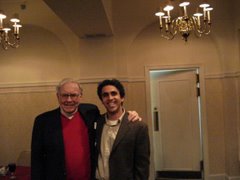
Here's Motley Fool contributor Emil Lee's second half of his interview with superinvestor Mohnish Pabrai. Click http://shamgad.blogspot.com/2007/02/mohnish-pabrais-perspectives-on.html for Part 1.
Emil Lee: How do you do your due diligence? Do you generally stick to industries you are already familiar with? How in-depth do you get, in terms of studying a company, its industry, and its competitors? Do you talk to a lot of people in the industry?
Mohnish Pabrai: I don't call or meet with management or company insiders. I do rely, from time to time, on the investors in Pabrai Funds. I am blessed to have a large contingent of CEOs and entrepreneurs as investors. Many of these folks know their industry cold. So, if I'm looking at something in real estate, there are [a] few real estate experts in my circle. I read up on the business, try to honestly assess whether it is within my circle of competence, and then send my thesis to the investors with domain knowledge and get their perspective.
Lee: You don't use Excel models. How do you keep track of all the moving parts (i.e. unit costs, discounted cash flow)? Are the economics of your investment ideas so compelling/simplistic that they can be done on the back of an envelope?
Pabrai: Usually two to three variables control most of the outcome. The rest is noise. If you can handicap how those key variables are approximately likely to play out, then you have a basis to do something. Things that are approximate and probabilistic don't lend themselves too well to Excel modeling. For me, if I find myself reaching for Excel, it is a very strong sign to take a pass. The thesis ought to be painfully simple in your head.
Lee: There's a ton of books about value investing, but very few about "special situation" or "event driven" investments -- do you recommend any books/magazines? Do you recommend any other business publications/trade magazines? Also, you mentioned Timothy Rick in Altucher's book -- I couldn't find anything on him (was it supposed to be Timothy Vick?) -- can you point me in the right direction?
Pabrai: Yes, it's Tim Vick. Buffett has spoken and written a lot about special situations. One should read up on the Buffett Partnership letters and Shareholder letters, as well as the annual meeting transcripts printed in OID. Tim talks about it in his book as well. Finova was a recent Buffett Special Situation, as were his adventures with Level 3 (Nasdaq: LVLT) Bonds, Korean stocks, American Express (NYSE: AXP) in the 1960s, etc.
Lee: What do you hope to accomplish with your new book? Is there a message or point you'd like readers to pay particular attention to?
Pabrai: The best way to learn is to teach. Writing the book was tremendously helpful for me to systematize the framework that I had in my head. I enjoyed writing it. I wrote it for the intelligent individual investor. And I wrote it for the great-grandkids that I'll probably never meet. If it improves the investing results of a few humans, I'd consider it a success.
Lee: Do you have any additional advice that would be helpful to people like me, who are trying to learn as much as possible about investing?
Pabrai: Pursue your passion, whatever it is. If you pursue what you love, you're pretty much assured of doing well at it. If investing is your passion, then study the best intently. The best investor is Warren Buffett and he's an open book. I'd suggest spending all one's energies getting to understand Buffett's modus operandi. To the extent that it's consistent with your temperament, adopt it.
Monday, February 26, 2007


Sunday, February 25, 2007
Mason Hawkins on 2006
A couple of months ago, I wrote an article on this blog about Mason Hawkins and his deep commitment in running his three funds at Longleaf as a true partnership between the managers and investors. Let me re-post the first two Guiding Principles of Longleaf:
1. "We will treat your investment...as if it were our own."
2. "We will remain significant investors with you..."
Mason Hawkin's Annual Letter to Partners has just come and I wanted to share some highlights. (read the whole thing at http://www.longleafpartners.com/pdfs/06_q4.pdf. It's a wonderful document and truly reflects how managers should communicate with their investors)
Here's Mr. Hawkins take on 2006 and the investing climate in general:
We have no view on what markets will do, but this environment presents a challenge as we enter 2007. There are few available bargains as we look for new opportunities to strengthen the foundation for compounding over the next five years. The domestic “on deck” list of potential investments is relatively small, but we are buying several new international companies.
Spoken like a true creator of long-term value.
Our long term success has emanated from several core principles:
1. "We will treat your investment...as if it were our own."
2. "We will remain significant investors with you..."
Mason Hawkin's Annual Letter to Partners has just come and I wanted to share some highlights. (read the whole thing at http://www.longleafpartners.com/pdfs/06_q4.pdf. It's a wonderful document and truly reflects how managers should communicate with their investors)
Here's Mr. Hawkins take on 2006 and the investing climate in general:
We have no view on what markets will do, but this environment presents a challenge as we enter 2007. There are few available bargains as we look for new opportunities to strengthen the foundation for compounding over the next five years. The domestic “on deck” list of potential investments is relatively small, but we are buying several new international companies.
Spoken like a true creator of long-term value.
Our long term success has emanated from several core principles:
- Buy a business with expected value growth
- Parnter with capable, honorable management
- Pay a signifcant discount for stocks
- Invest with a minimum five year horizon, deferring taxes and minimizing transaction costs
- Charge reasonable fees
What has all of this done for Longleaf under the tutelege of Mason Hawkins? I will let the numbers speak for themselves (results are 10 year annualized returns)
Longleaf Partners Fund - 12.8% vs. 8.4% for S&P 500
Longleaf Small Cap - 14.5% vs. 9.4% for Russell 2000
Longleaf Int'l - 15.5% vs. 8.0% for EAFE
Friday, February 23, 2007
Mohnish Pabrai's Perspectives on Investing
Emil Lee from the Motley Fool recently had a chance to sit with Mohnish Pabrai and discuss his investment philosophy, his similarity to Warren Buffet, and his amazing track record. Here are excerpts from the first part of the interview:
Emil Lee: You've modeled your partnership after the Buffett Partnership -- do you mind providing any detail on how that's going? Are you on track in terms of performance, assets under management, etc.?
Mohnish Pabrai: It has gone far better than I would have forecasted. Mr. Buffett deserves all the credit. I am just a shameless cloner. A $100,000 investment in Pabrai Funds at inception (on July 1, 1999) was worth $659,700 on Dec. 31, 2006. That's seven and a half years. The annualized return is 28.6% -- after my outrageous fees and all expenses. Assets under management are over $400 million -- up from $1 million at inception. On all fronts, Pabrai Funds has done vastly better than my best-case expectations.
Going forward, I expect we'll continue to beat the major indices, but with just a small average annualized outperformance.
Lee: You clearly believe in having a broad latticework of knowledge from different educational disciplines from which to draw upon when judging investment ideas. Can you describe how you spend your day? Do you devote a general percentage of your time to reading "non-investment" material versus 10-Ks, etc.?
Pabrai: My calendar is mostly empty. I try to have no more than one meeting a week. Beyond that, the way the day is spent is quite open. If I'm in the midst of drilling down on a stock, I might spend a few days just focused on reading documents related to that one business. Other times, I'm usually in the midst of some book, and part of the day goes to keeping up with correspondence -- mostly email.
I take a nap nearly every afternoon. There is a separate room with a bed in our offices. And I usually stay up late. So some reading, etc., is at night.
Lee: In Trade Like Warren Buffett, you mention that you let investment ideas come to you by reading a lot, and also monitoring familiar names on the NYSE. Can you describe your process of generating investment ideas -- is it simply just reading a lot? Do you do anything else to actively seek out ideas?
Pabrai: The No. 1 skill that a successful investor needs is patience. You need to let the game come to you. My steady-state modus operandi is to assume that I'm just a gentleman of leisure, and that I'm not in the investment business. If something looks so compelling that it screams out at me, saying "Buy me!!," I then do a drill-down. Otherwise, I'm just reading for reading's sake. So, I scan a few sources and usually can find something scream out at me a few times a year. These sources (in no particular order) are:
1. 52-Week Lows on the NYSE (published daily in The Wall Street Journal and weekly in Barron's)
2. Value Line (look at their various "bottoms lists" weekly)
3. Outstanding Investor Digest (www.oid.com)
4. Value Investor Insight (www.valueinvestorinsight.com)
5. Portfolio Reports (from the folks who put out OID)
6. The Wall Street Journal
7. Financial Times
8. Barron's
9. Forbes
10. Fortune
11. BusinessWeek
12. The Sunday New York Times
13. The Value Investors' Club (www.valueinvestorsclub.com)
14. Magic Formula (www.magicformulainvesting.com)
15. Guru Focus (www.gurufocus.com)
Between all of the above, I have historically found at least three to four good ideas every year. Sometimes I make a mistake, and a good idea turns out to be not so good.
Lee: A big part of investing is knowing what to pay attention to and what not to [focus on]. How do you sift through the thousands of investment ideas? Often, bargains are bargains because they're unrecognizable -- how do you spot the needles in the haystack, and how do you avoid the value traps?
Pabrai: I wait to hear the scream. "Buy me!" It needs to be really loud, as I'm a bit hard of hearing.
Lee: Would it be fair to say you are more balance sheet-oriented, versus income/cash flow statement-oriented? If so, how do you get comfortable with the asset values (i.e., Frontline, death care)?
Pabrai: John Burr Williams was the first to define intrinsic value in his The Theory of Investment Value, published in 1938. Per Williams, the intrinsic value of any business is determined by the cash inflows and outflows -- discounted at an appropriate interest rate -- that can be expected to occur during the remaining life of the business. The definition is painfully simple. So, cash can be gotten out of a business in a liquidation or by cash the business generates year after year. It is all a question of what is the likelihood of each. If future cash flows are easy to figure out and are high-probability events, then liquidation value can be set aside. On the other hand, sometimes the only thing that is a high probability of value is liquidation value. Both work. Depends on the situation. But you first need to hear a scream ...
Emil Lee: You've modeled your partnership after the Buffett Partnership -- do you mind providing any detail on how that's going? Are you on track in terms of performance, assets under management, etc.?
Mohnish Pabrai: It has gone far better than I would have forecasted. Mr. Buffett deserves all the credit. I am just a shameless cloner. A $100,000 investment in Pabrai Funds at inception (on July 1, 1999) was worth $659,700 on Dec. 31, 2006. That's seven and a half years. The annualized return is 28.6% -- after my outrageous fees and all expenses. Assets under management are over $400 million -- up from $1 million at inception. On all fronts, Pabrai Funds has done vastly better than my best-case expectations.
Going forward, I expect we'll continue to beat the major indices, but with just a small average annualized outperformance.
Lee: You clearly believe in having a broad latticework of knowledge from different educational disciplines from which to draw upon when judging investment ideas. Can you describe how you spend your day? Do you devote a general percentage of your time to reading "non-investment" material versus 10-Ks, etc.?
Pabrai: My calendar is mostly empty. I try to have no more than one meeting a week. Beyond that, the way the day is spent is quite open. If I'm in the midst of drilling down on a stock, I might spend a few days just focused on reading documents related to that one business. Other times, I'm usually in the midst of some book, and part of the day goes to keeping up with correspondence -- mostly email.
I take a nap nearly every afternoon. There is a separate room with a bed in our offices. And I usually stay up late. So some reading, etc., is at night.
Lee: In Trade Like Warren Buffett, you mention that you let investment ideas come to you by reading a lot, and also monitoring familiar names on the NYSE. Can you describe your process of generating investment ideas -- is it simply just reading a lot? Do you do anything else to actively seek out ideas?
Pabrai: The No. 1 skill that a successful investor needs is patience. You need to let the game come to you. My steady-state modus operandi is to assume that I'm just a gentleman of leisure, and that I'm not in the investment business. If something looks so compelling that it screams out at me, saying "Buy me!!," I then do a drill-down. Otherwise, I'm just reading for reading's sake. So, I scan a few sources and usually can find something scream out at me a few times a year. These sources (in no particular order) are:
1. 52-Week Lows on the NYSE (published daily in The Wall Street Journal and weekly in Barron's)
2. Value Line (look at their various "bottoms lists" weekly)
3. Outstanding Investor Digest (www.oid.com)
4. Value Investor Insight (www.valueinvestorinsight.com)
5. Portfolio Reports (from the folks who put out OID)
6. The Wall Street Journal
7. Financial Times
8. Barron's
9. Forbes
10. Fortune
11. BusinessWeek
12. The Sunday New York Times
13. The Value Investors' Club (www.valueinvestorsclub.com)
14. Magic Formula (www.magicformulainvesting.com)
15. Guru Focus (www.gurufocus.com)
Between all of the above, I have historically found at least three to four good ideas every year. Sometimes I make a mistake, and a good idea turns out to be not so good.
Lee: A big part of investing is knowing what to pay attention to and what not to [focus on]. How do you sift through the thousands of investment ideas? Often, bargains are bargains because they're unrecognizable -- how do you spot the needles in the haystack, and how do you avoid the value traps?
Pabrai: I wait to hear the scream. "Buy me!" It needs to be really loud, as I'm a bit hard of hearing.
Lee: Would it be fair to say you are more balance sheet-oriented, versus income/cash flow statement-oriented? If so, how do you get comfortable with the asset values (i.e., Frontline, death care)?
Pabrai: John Burr Williams was the first to define intrinsic value in his The Theory of Investment Value, published in 1938. Per Williams, the intrinsic value of any business is determined by the cash inflows and outflows -- discounted at an appropriate interest rate -- that can be expected to occur during the remaining life of the business. The definition is painfully simple. So, cash can be gotten out of a business in a liquidation or by cash the business generates year after year. It is all a question of what is the likelihood of each. If future cash flows are easy to figure out and are high-probability events, then liquidation value can be set aside. On the other hand, sometimes the only thing that is a high probability of value is liquidation value. Both work. Depends on the situation. But you first need to hear a scream ...
Sunday, January 28, 2007
Monday, January 22, 2007
Buffett Speaks
I just returned from a two day visit to Omaha, Nebraska to visit with Warren Buffett at Berkshire Hathaway. I took along 50 of my fellow MBA classmates. As expected, the Sage of Omaha was full of humor while dispensing his unique, masterful thoughts on business and life.
Unlike most student visits to Omaha, this one was unique in that we had extensive access to Mr. Buffett...nearly seven hours over the course of two days. Most schools consider it a major coup to score 2 hours with him and others spend tens of thousands of dollars for a two hour lunch with Buffett (see eBay for future lunch dates).
The time was priceless...we spoke of the early years with Buffett working for Ben Graham, the formation of the legendary partnership in 1956, his remarkable gift to the Bill and Melinda Gates foundation, and of course, investing.
The notes of this trip will be available on this blog shortly. For now, I will share some highlights of the meeting.
I asked Buffett about the state of the securities markets in the U.S. going forward and how they will compare to the period in which he operated and how he could make 50% or more per year...
Buffett: "It's a structural issue...yes, with a small sum like a million dollars, I could make 50% or more a year. The key is rationality. There are always going to be times when humans act irrational and this is time to make your money. I've made a career of cashing in when people act irrational."
If you consider some of Buffett's most successful investments--American Express, the Washington Post Company, and Gieco--they were all made during the absolute worst times for these companies. Times when nobody wanted anything to do with them.
Buffett then picked up a copy of the 2004 Citigroup Investment Guide to Korean stocks and began flipping through the pages,
Buffett: "A couple of years ago I got this investment guide on Korean stocks. I began looking through. It felt like it was 1974 all over again. Look here at this company...Dehan, I don't know how you pronounce it, Flour Company. It earned 12,879 won previously. It currently had a book value of 200,000 won and was earning 18,000 won. It had traded as high as 43,000 and as low as 35,000 won. At the time, the current price was 40,000 or 2 times earnings. In 4 hours I had found 2o companies like this."
What Buffett said next is critical,
Referring to having found 2o or so companies like Dehan Flour Buffett remarks,
"When you invest like this, you will make money. Sure 1 or 2 companies may turn out to be poor choices, but the others will more than make up for any losses."
It's critical to understand the mental model Buffett has going into these investments in Korea. A portfolio of carefully selected stocks in understandable businesses trading at very attractive valuations generate abnormal returns. While I don't have Buffett's personal investment record, I am certain he was making 40-50% returns in Korea simply by choosing a portfolio of stocks with strong earnings records trading at very low multiples to earnings. Ironically, this model is not new...it was actually revealed by efficient market advocates Fama and French in there three-factor model. Over time, low P/E, low book, small companies tend to outperform. Apply a little more intensity, as Buffett is famous for doing, and you can make lots of money.
One of Buffett's most successful international investments was PetroChina, China's largest oil producer.
Buffett: "The whole company was selling for $35 billion. It was selling for one-fourth of the price of Exxon, but was making profits equal to 80% of Exxon. I was reading the annual report one day and in it I saw a message from the Chairman saying that the company would pay out 45% of its profits as dividends. This was much more than any company like this, and I liked the reserves."
The Chinese government owns 90% of PetroChina, so only 10% was available to outside investors. Even with this lopsided ownership, Buffett liked the company enough to buy 13% (actually 1.3% of 10%, but Buffett likes to joke that the company is owned by him and the Chinese gov't)
"I was considering buying this company, but I was also looking at Yukos in Russia. This was cheap, too. I decided I’d rather be in China than Russia. I liked the investment climate better in China. In July, the owner of Yukos, Mikhail Khodorkovsky (at that time, the richest man in Russia) had breakfast with me and was asking for my consultation if they should expand into New York and if this was too onerous considering the SEC regs. Four months later, Khodorkovsky was in prison. Putin put him in. He took on Putin and lost. His decision on geopolitical thinking was wrong and now the company is finished. Petro China was the superior investment choice. 45% was a crazy amount of dividends to offer but China kept its word. I am never quite as happy as I am in the US, because the laws are more uncertain elsewhere, but the point is to buy things cheap."
Once again, "the point is to buy things cheap." Because the company is not in the U.S., Buffett applies more filters before committing capital.
"So we own 1.3% of this company and it cost us around $400 million. Now it's worth $3 billion."
Look closer and you can see the real value in this investment...the dividend payout. When Buffett made his investment, PetroChina was paying a dividend of close to 9-10% (I know because I bought some shares the minute I heard of Buffett's stake and about 5 minutes of my own research.) At the time the stock price was about $30 per ADR, but Buffett purchased H shares directly in China at a lower price. The stock currently trades at about $125 per ADR and yields 5%...you do the math...about $6 per share on a $30 cost basis or even lower...margin of safety?
Buffett also had a copy of the 1951 Moody's Banking and Insurance Manual.
"There were four Moody's manuals at the time. I went through them all, page by page, over 10,000 pages. On page 1433, I found Western Insurance Securities. Its earnings per share were as follows: 1949 - $21.66, 1950 - $29.09. In 1951, the low-high share price was $3 - $13. Ten pages later, on page 1443, I found National American Fire Insurance (“This book really got hot towards the end!”) NAFI was controlled by an Omaha guy, one of the richest men in the country, who owned many of the best run insurance companies in the country. He stashed the crown jewels of his insurance holdings in NAFI. In 1950, it earned $29.02. The share price was $27. Book value was $135. This company was located right here in Omaha, right around the corner from I was working as a broker. None of the brokers knew about it. This book made me rich."
Sham Gad can be reached at shamgad@gmail.com
Unlike most student visits to Omaha, this one was unique in that we had extensive access to Mr. Buffett...nearly seven hours over the course of two days. Most schools consider it a major coup to score 2 hours with him and others spend tens of thousands of dollars for a two hour lunch with Buffett (see eBay for future lunch dates).
The time was priceless...we spoke of the early years with Buffett working for Ben Graham, the formation of the legendary partnership in 1956, his remarkable gift to the Bill and Melinda Gates foundation, and of course, investing.
The notes of this trip will be available on this blog shortly. For now, I will share some highlights of the meeting.
I asked Buffett about the state of the securities markets in the U.S. going forward and how they will compare to the period in which he operated and how he could make 50% or more per year...
Buffett: "It's a structural issue...yes, with a small sum like a million dollars, I could make 50% or more a year. The key is rationality. There are always going to be times when humans act irrational and this is time to make your money. I've made a career of cashing in when people act irrational."
If you consider some of Buffett's most successful investments--American Express, the Washington Post Company, and Gieco--they were all made during the absolute worst times for these companies. Times when nobody wanted anything to do with them.
Buffett then picked up a copy of the 2004 Citigroup Investment Guide to Korean stocks and began flipping through the pages,
Buffett: "A couple of years ago I got this investment guide on Korean stocks. I began looking through. It felt like it was 1974 all over again. Look here at this company...Dehan, I don't know how you pronounce it, Flour Company. It earned 12,879 won previously. It currently had a book value of 200,000 won and was earning 18,000 won. It had traded as high as 43,000 and as low as 35,000 won. At the time, the current price was 40,000 or 2 times earnings. In 4 hours I had found 2o companies like this."
What Buffett said next is critical,
Referring to having found 2o or so companies like Dehan Flour Buffett remarks,
"When you invest like this, you will make money. Sure 1 or 2 companies may turn out to be poor choices, but the others will more than make up for any losses."
It's critical to understand the mental model Buffett has going into these investments in Korea. A portfolio of carefully selected stocks in understandable businesses trading at very attractive valuations generate abnormal returns. While I don't have Buffett's personal investment record, I am certain he was making 40-50% returns in Korea simply by choosing a portfolio of stocks with strong earnings records trading at very low multiples to earnings. Ironically, this model is not new...it was actually revealed by efficient market advocates Fama and French in there three-factor model. Over time, low P/E, low book, small companies tend to outperform. Apply a little more intensity, as Buffett is famous for doing, and you can make lots of money.
One of Buffett's most successful international investments was PetroChina, China's largest oil producer.
Buffett: "The whole company was selling for $35 billion. It was selling for one-fourth of the price of Exxon, but was making profits equal to 80% of Exxon. I was reading the annual report one day and in it I saw a message from the Chairman saying that the company would pay out 45% of its profits as dividends. This was much more than any company like this, and I liked the reserves."
The Chinese government owns 90% of PetroChina, so only 10% was available to outside investors. Even with this lopsided ownership, Buffett liked the company enough to buy 13% (actually 1.3% of 10%, but Buffett likes to joke that the company is owned by him and the Chinese gov't)
"I was considering buying this company, but I was also looking at Yukos in Russia. This was cheap, too. I decided I’d rather be in China than Russia. I liked the investment climate better in China. In July, the owner of Yukos, Mikhail Khodorkovsky (at that time, the richest man in Russia) had breakfast with me and was asking for my consultation if they should expand into New York and if this was too onerous considering the SEC regs. Four months later, Khodorkovsky was in prison. Putin put him in. He took on Putin and lost. His decision on geopolitical thinking was wrong and now the company is finished. Petro China was the superior investment choice. 45% was a crazy amount of dividends to offer but China kept its word. I am never quite as happy as I am in the US, because the laws are more uncertain elsewhere, but the point is to buy things cheap."
Once again, "the point is to buy things cheap." Because the company is not in the U.S., Buffett applies more filters before committing capital.
"So we own 1.3% of this company and it cost us around $400 million. Now it's worth $3 billion."
Look closer and you can see the real value in this investment...the dividend payout. When Buffett made his investment, PetroChina was paying a dividend of close to 9-10% (I know because I bought some shares the minute I heard of Buffett's stake and about 5 minutes of my own research.) At the time the stock price was about $30 per ADR, but Buffett purchased H shares directly in China at a lower price. The stock currently trades at about $125 per ADR and yields 5%...you do the math...about $6 per share on a $30 cost basis or even lower...margin of safety?
Buffett also had a copy of the 1951 Moody's Banking and Insurance Manual.
"There were four Moody's manuals at the time. I went through them all, page by page, over 10,000 pages. On page 1433, I found Western Insurance Securities. Its earnings per share were as follows: 1949 - $21.66, 1950 - $29.09. In 1951, the low-high share price was $3 - $13. Ten pages later, on page 1443, I found National American Fire Insurance (“This book really got hot towards the end!”) NAFI was controlled by an Omaha guy, one of the richest men in the country, who owned many of the best run insurance companies in the country. He stashed the crown jewels of his insurance holdings in NAFI. In 1950, it earned $29.02. The share price was $27. Book value was $135. This company was located right here in Omaha, right around the corner from I was working as a broker. None of the brokers knew about it. This book made me rich."
Sham Gad can be reached at shamgad@gmail.com
Monday, December 25, 2006
The Warren Buffett of Mutual Fund Investing?
No, I am not talking about Peter Lynch, although Mr. Lynch is arguably one of the best mutual fund managers and investors of his era. Nope, the gentleman I am referring to runs a mutual fund company that is quite simply unique amongst its peers. Consider the firm's statement of principles found on the first page of the prospectus:
1. "We will treat your investment...as if it were our own."
2. "We will remain significant investors with you..."
Sound familiar? Buffett and Munger subscribe to the same principles at Berkshire Hathaway by "eating our own cooking." Mutual funds are not exactly known for their high insider ownership, although a few diamonds in the rough can be found.
The fellow I am referring to is none other than Mason Hawkins, investment guru extraordinaire and chairman of Longleaf Partners, a value oriented mutual fund family. The word partner in the company name is richly deserved...each investor in Longleaf is viewed as a long term partner.
I must admit, I have known of Mr. Hawkins for some time now, but it was only recently that I discovered where Mr. Hawkins earned his MBA...the University of Georgia. As a current MBA candidate at UGA, I was euphoric that UGA boasts as an alumnus one of the greatest money managers of our time....who adheres to the value principles espoused by Ben Graham. Needless to say, my recent discovery sent me on a search to learn as much as I could about Mr. Hawkins and the his wonderful canvas, Longleaf.
To really appreciate Mr. Hawkin's partnership approach with his investors, all you need to do is consider how Longleaf came to be. Longleaf was basically started by Mr. Hawkins in 1987 when he introduced it to Southeastern Asset Management. Since 1975, SAM was a respected value oriented firm. Longleaf was created so Mr. Hawkins could essentially pool his money alongside his clients without creating the conflict of interest that can arise when money managers buy and sell for their own accounts. Mr. Hawkins bought all the same securities held by SAM and then put all his and his colleagues money into it. If that ain't eating your own cooking, I don't know what is. Mr. Hawkins went even further when he prohibited Southeastern's employees from investing in any of their bonuses and profits outside of Longleaf...talk about a true partnership with your clients.
I recently uncovered a gem of a paper written a few years back about Longleaf and Mr. Hawkins that really illustrates the viewpoints of Longleaf and its founders:
When Mr. Hawkins was a high school senior, he read Graham's "The Intelligent Investor" and remarked,
"The single thing that Graham talks about that allows for success is establishing firmly what a company is worth. Only if you've done rigorous analytical work that has a high probability of being right can you control your emotions and act against the collective mind-set of the moment."
Staley Cates, a colleague at Longleaf aptly says,
"We believe risk goes down when you put your money only in the investments you understand very well."
The folks at Longleaf have been compounding money in excess of thier respective benchmarks for a long time. With a track record like that, Longleaf would have no problem attracting funds. Instead Longleaf decided to close out two of its funds several years ago and forgo all those lucrative asset management fees. When Mr. Hawkins decided to close the funds to new investors, he was doing so at peak performance and could have attracted capital at the snap of a finger. Instead, as all true intelligent investors do, he chose not to.
"If we'd kept the Funds open, we could have maximized our fee income but we would have damaged our record and impaired our ability to compound our own capital as well as our customers'. So we closed them."
Mr. Hawkins will only reopen the funds when the economics are right to put more assets to work....in other words when stocks are cheap. Indeed since 1995 when Mr. Hawkins closed the Partners Fund to new investments and in 1997 when he closed the Small Cap, Mr. Market has created pockets of opportunities to reopen them and as a result, both new and existing partners have been handsomely enriched. While there are several mutual fund outfits that align their interests with those of outside shareholders, I haven't come across any that are as methodical about it as Longleaf.
It's really important to consider that Mr. Hawkins and his team could have gotten very rich a lot quicker by running their funds geared at maximizing short term profits, but instead they choose to get rich slowly alongside their partners. According to Charlie Munger, "why should it be easy to get rich?" And that is exactly how it should be.
Each year Longleaf hosts a annual shareholder meeting that gives their investor's a chance to get their questions answered. Like Berkshire, Longleaf strives to treat their shareholders fairly and in the process, Mason Hawkins, like Warren Buffett, is beating the pants off mutual fund managers.
1. "We will treat your investment...as if it were our own."
2. "We will remain significant investors with you..."
Sound familiar? Buffett and Munger subscribe to the same principles at Berkshire Hathaway by "eating our own cooking." Mutual funds are not exactly known for their high insider ownership, although a few diamonds in the rough can be found.
The fellow I am referring to is none other than Mason Hawkins, investment guru extraordinaire and chairman of Longleaf Partners, a value oriented mutual fund family. The word partner in the company name is richly deserved...each investor in Longleaf is viewed as a long term partner.
I must admit, I have known of Mr. Hawkins for some time now, but it was only recently that I discovered where Mr. Hawkins earned his MBA...the University of Georgia. As a current MBA candidate at UGA, I was euphoric that UGA boasts as an alumnus one of the greatest money managers of our time....who adheres to the value principles espoused by Ben Graham. Needless to say, my recent discovery sent me on a search to learn as much as I could about Mr. Hawkins and the his wonderful canvas, Longleaf.
To really appreciate Mr. Hawkin's partnership approach with his investors, all you need to do is consider how Longleaf came to be. Longleaf was basically started by Mr. Hawkins in 1987 when he introduced it to Southeastern Asset Management. Since 1975, SAM was a respected value oriented firm. Longleaf was created so Mr. Hawkins could essentially pool his money alongside his clients without creating the conflict of interest that can arise when money managers buy and sell for their own accounts. Mr. Hawkins bought all the same securities held by SAM and then put all his and his colleagues money into it. If that ain't eating your own cooking, I don't know what is. Mr. Hawkins went even further when he prohibited Southeastern's employees from investing in any of their bonuses and profits outside of Longleaf...talk about a true partnership with your clients.
I recently uncovered a gem of a paper written a few years back about Longleaf and Mr. Hawkins that really illustrates the viewpoints of Longleaf and its founders:
When Mr. Hawkins was a high school senior, he read Graham's "The Intelligent Investor" and remarked,
"The single thing that Graham talks about that allows for success is establishing firmly what a company is worth. Only if you've done rigorous analytical work that has a high probability of being right can you control your emotions and act against the collective mind-set of the moment."
Staley Cates, a colleague at Longleaf aptly says,
"We believe risk goes down when you put your money only in the investments you understand very well."
The folks at Longleaf have been compounding money in excess of thier respective benchmarks for a long time. With a track record like that, Longleaf would have no problem attracting funds. Instead Longleaf decided to close out two of its funds several years ago and forgo all those lucrative asset management fees. When Mr. Hawkins decided to close the funds to new investors, he was doing so at peak performance and could have attracted capital at the snap of a finger. Instead, as all true intelligent investors do, he chose not to.
"If we'd kept the Funds open, we could have maximized our fee income but we would have damaged our record and impaired our ability to compound our own capital as well as our customers'. So we closed them."
Mr. Hawkins will only reopen the funds when the economics are right to put more assets to work....in other words when stocks are cheap. Indeed since 1995 when Mr. Hawkins closed the Partners Fund to new investments and in 1997 when he closed the Small Cap, Mr. Market has created pockets of opportunities to reopen them and as a result, both new and existing partners have been handsomely enriched. While there are several mutual fund outfits that align their interests with those of outside shareholders, I haven't come across any that are as methodical about it as Longleaf.
It's really important to consider that Mr. Hawkins and his team could have gotten very rich a lot quicker by running their funds geared at maximizing short term profits, but instead they choose to get rich slowly alongside their partners. According to Charlie Munger, "why should it be easy to get rich?" And that is exactly how it should be.
Each year Longleaf hosts a annual shareholder meeting that gives their investor's a chance to get their questions answered. Like Berkshire, Longleaf strives to treat their shareholders fairly and in the process, Mason Hawkins, like Warren Buffett, is beating the pants off mutual fund managers.
Thursday, December 14, 2006
The Art of Deep Value Investing
Charlie Munger said it best when he remarked that, "All intelligent investing is value investing." Quite simply, value investing can be defined by two fundamental metrics:
1. Look for a business trading below its intrinsic value.
2. Invest with a margin of safety.
In other words, pay attention to price. A fantastic business is not a fantastic investment if the price is wrong. In my obsessive pursuit of understanding the true mechanics of Grahamian value investing, I went looking for some insights into the complex art of deep value investing. I found some wonderful words of wisdom from Seth Klarman, value investor extraordinaire and founder of The Baupost Group, a value driven hedge fund. Mr. Klarman has been compounding money at over a 23% clip for the past two decades. At a recent talk at the Columbia Business School, Mr. Klarman shared his thoughts....
“If only one word is to be used to describe what Baupost does, that word should be: ‘Mispricing’. We look for mispricing due to over-reaction,”
Markets are never completely efficient. There will be times when Mr. Market goes crazy and offers to sell dollar bills for fifty cents. Taking advantage of these opportunities can generate enormous returns. But to do so, you have to constantly be working and working and working...why should it be easy to get rich?
“Investors can not predict when business values will rise or fall. Valuation should always be performed conservatively, giving considerable weight to worst-case liquidation value and other methods.”
A margin of safety is achieved when securities are purchased at prices sufficiently below underlying value to allow for human error, bad luck, or extreme volatility in a complex, unpredictable and rapidly changing world,”
Consider the Washington Post Company in the early1970's. At one point, the market cap of the Post was around $80 million yet the media and publishing assets of the company could have easily fetched $400 million in a fire sale liquidation. Eighty cents for four dollars sounds like a pretty good margin of safety. Valuation is not an exact science...an adequate margin of safety, usually 50%, helps cushion against "volatility" and "bad luck."
Look at investments as "fractional ownerships."
How else should you look at buying shares in a business?
Ultimately, investments generate profits in three ways:
1. From the free cash flow generated by the underlying business, which will eventually be reflected in a higher share price or distributed as dividends.
2. From an increase in the multiple that investors are willing to pay for the underlying business as reflected in a higher share price.
3. Or by closing the gap between share price and underlying business value.
So how do you find profitable investments?
"Value investing requires a great deal of hard work, unusually strict discipline and a long-term investment horizon"
Seth Klarman wrote a book, Margin of Safety, that is a blueprint for a sound investment approach. Unfortunately, the book is out of print and last time I checked, a copy was fetching over $1300 on eBay. However, most university libraries ought to have a copy or should be able to be able to point you in the right direction.
1. Look for a business trading below its intrinsic value.
2. Invest with a margin of safety.
In other words, pay attention to price. A fantastic business is not a fantastic investment if the price is wrong. In my obsessive pursuit of understanding the true mechanics of Grahamian value investing, I went looking for some insights into the complex art of deep value investing. I found some wonderful words of wisdom from Seth Klarman, value investor extraordinaire and founder of The Baupost Group, a value driven hedge fund. Mr. Klarman has been compounding money at over a 23% clip for the past two decades. At a recent talk at the Columbia Business School, Mr. Klarman shared his thoughts....
“If only one word is to be used to describe what Baupost does, that word should be: ‘Mispricing’. We look for mispricing due to over-reaction,”
Markets are never completely efficient. There will be times when Mr. Market goes crazy and offers to sell dollar bills for fifty cents. Taking advantage of these opportunities can generate enormous returns. But to do so, you have to constantly be working and working and working...why should it be easy to get rich?
“Investors can not predict when business values will rise or fall. Valuation should always be performed conservatively, giving considerable weight to worst-case liquidation value and other methods.”
A margin of safety is achieved when securities are purchased at prices sufficiently below underlying value to allow for human error, bad luck, or extreme volatility in a complex, unpredictable and rapidly changing world,”
Consider the Washington Post Company in the early1970's. At one point, the market cap of the Post was around $80 million yet the media and publishing assets of the company could have easily fetched $400 million in a fire sale liquidation. Eighty cents for four dollars sounds like a pretty good margin of safety. Valuation is not an exact science...an adequate margin of safety, usually 50%, helps cushion against "volatility" and "bad luck."
Look at investments as "fractional ownerships."
How else should you look at buying shares in a business?
Ultimately, investments generate profits in three ways:
1. From the free cash flow generated by the underlying business, which will eventually be reflected in a higher share price or distributed as dividends.
2. From an increase in the multiple that investors are willing to pay for the underlying business as reflected in a higher share price.
3. Or by closing the gap between share price and underlying business value.
So how do you find profitable investments?
"Value investing requires a great deal of hard work, unusually strict discipline and a long-term investment horizon"
Seth Klarman wrote a book, Margin of Safety, that is a blueprint for a sound investment approach. Unfortunately, the book is out of print and last time I checked, a copy was fetching over $1300 on eBay. However, most university libraries ought to have a copy or should be able to be able to point you in the right direction.
Friday, December 1, 2006
A Thought On Investing
Author's note: I orginally wrote this article several years ago in response to the puzzled looks I got when I was telling my friends (I was 22 at the time) about value investing and this guy in Omaha, Nebraska that was beating the pants off Wall Street practicing it.
Fact: Between 1984 and 1999, a great bull market in America, 90 percent of mutual fund managers underperformed the Wilshire 5000 Index, a relatively low bar to beat.
Ninety percent. Think about this for a moment. Only one out of ten “expert” mutual fund managers generated a return higher than that of the overall general market. Why does this happen? How is it that an overwhelming majority of intelligent professionals fail to produce a par result for their investors? The answer is two-fold: First, mutual fund managers tend to focus on short-term results and second, they tend to follow the herd. Mutual fund managers define their investment strategy with particular styles such as “small-cap value” or “small cap growth” to isolate the parameters that guide their portfolio selections. Any business that does not fit into the particular investment focus of the fund is screened out, regardless of its suitability for investment. The reason mutual-fund managers limit themselves to a particular class of equities is doing so appears rational and is therefore seen as the safest option. Who wants to ever appear irrational? This rationality (or lack thereof) is how mutual fund managers are able to justify their performance to their investors.
Investors, wanting evidence that a mutual-fund manager’s decisions are reasonable, compare his decisions and performance with his peers. Mutual fund managers, knowing this investor behavior and anxious to protect their jobs, simply mimic their peers. This mimicking destroys whatever informational advantage they had leading to a shortage in investment possibilities and any informational advantage they had to begin with. As John Maynard Keynes wrote in The General Theory of Employment, Interest and Money, “Worldly wisdom teaches that it is better for reputation to fail conventionally than to succeed unconventionally.” What does all this say about mutual fund managers? That, in their goal of wanting to do what seems to be safest, they follow the crowd, resulting in performance below that of the general market by sticking to the same investments as their peer groups.
Fortunately for investors, they have some options: Two options are index funds and what legendary investor Warren Buffett terms “super investors.” While the focus of this article is on the latter, a simple word on the former. Index funds are a great way to mimic the market without the necessary (sometimes outrageous) fees of a mutual fund. These low cost passively managed funds are, in general, far superior investments to mutual funds in many asset classes. However it is possible to have consistent marketing beating returns—by a healthy margin at that. When you think about trouncing the market, names such as Bill Ruane of the famed Sequoia Fund, Warren Buffett of Berkshire Hathaway, Peter Lynch of Fidelity, Walter Schloss, and Rick Guevin come to mind. Mr. Guevin never attended business school; Mr. Schloss never even went to college (I am not suggesting avoiding an education, something this author values tremendously, but merely to suggest that a pedigree MBA does not necessarily give you an advantage). Some of these names stand out more than others, but all of them and dozens like them have amassed equally astonishing performances year after year through bull and bear markets. And they did it in their own way. Walter Schloss owned stocks that Bill Ruane did not own that Peter Lynch did not own and so forth. The common thread amongst these super investors is their relentless pursuit for quality investments at attractive prices, otherwise known as value investing. Warren Buffet beautifully illustrates this idea as “buying dollar bills for fifty cents.” This discipline, coupled with patience and total lack of emotion from the daily market swings, has served these investors amazingly over decades.
Ben Graham, the dean of value investing and a mentor to the some of the greatest investors, has said “investing is most prudent when it is most business-like.” A simple concept, but one that very few mutual fund managers practice. When you purchase a home, you hunt for a good price, safety, and a quality neighborhood and neighbors. You do your research and then purchase the most attractive home giving strong consideration to these factors. Investing and investment managers must be the same way, so as not to be mistaken for speculation. You want a bargain, safety, and a quality business and management. While I certainly cannot expect all investors to manage their own money—I would have no job or livelihood if that were the case—investors must demand market-beating performances from their financial gatekeepers if they are to justify the fees that they pay them to manage their money. Thankfully for us, we are fortunate to have some money managers and investors who don’t follow the herd.
Sham Gad, a 2007 MBA candidate, is currently working to establish Gad Investment Partners, an investment partnership inspired by the work of Graham and Buffett. I welcome all comments and suggestions to shamgad@gmail.com.
Fact: Between 1984 and 1999, a great bull market in America, 90 percent of mutual fund managers underperformed the Wilshire 5000 Index, a relatively low bar to beat.
Ninety percent. Think about this for a moment. Only one out of ten “expert” mutual fund managers generated a return higher than that of the overall general market. Why does this happen? How is it that an overwhelming majority of intelligent professionals fail to produce a par result for their investors? The answer is two-fold: First, mutual fund managers tend to focus on short-term results and second, they tend to follow the herd. Mutual fund managers define their investment strategy with particular styles such as “small-cap value” or “small cap growth” to isolate the parameters that guide their portfolio selections. Any business that does not fit into the particular investment focus of the fund is screened out, regardless of its suitability for investment. The reason mutual-fund managers limit themselves to a particular class of equities is doing so appears rational and is therefore seen as the safest option. Who wants to ever appear irrational? This rationality (or lack thereof) is how mutual fund managers are able to justify their performance to their investors.
Investors, wanting evidence that a mutual-fund manager’s decisions are reasonable, compare his decisions and performance with his peers. Mutual fund managers, knowing this investor behavior and anxious to protect their jobs, simply mimic their peers. This mimicking destroys whatever informational advantage they had leading to a shortage in investment possibilities and any informational advantage they had to begin with. As John Maynard Keynes wrote in The General Theory of Employment, Interest and Money, “Worldly wisdom teaches that it is better for reputation to fail conventionally than to succeed unconventionally.” What does all this say about mutual fund managers? That, in their goal of wanting to do what seems to be safest, they follow the crowd, resulting in performance below that of the general market by sticking to the same investments as their peer groups.
Fortunately for investors, they have some options: Two options are index funds and what legendary investor Warren Buffett terms “super investors.” While the focus of this article is on the latter, a simple word on the former. Index funds are a great way to mimic the market without the necessary (sometimes outrageous) fees of a mutual fund. These low cost passively managed funds are, in general, far superior investments to mutual funds in many asset classes. However it is possible to have consistent marketing beating returns—by a healthy margin at that. When you think about trouncing the market, names such as Bill Ruane of the famed Sequoia Fund, Warren Buffett of Berkshire Hathaway, Peter Lynch of Fidelity, Walter Schloss, and Rick Guevin come to mind. Mr. Guevin never attended business school; Mr. Schloss never even went to college (I am not suggesting avoiding an education, something this author values tremendously, but merely to suggest that a pedigree MBA does not necessarily give you an advantage). Some of these names stand out more than others, but all of them and dozens like them have amassed equally astonishing performances year after year through bull and bear markets. And they did it in their own way. Walter Schloss owned stocks that Bill Ruane did not own that Peter Lynch did not own and so forth. The common thread amongst these super investors is their relentless pursuit for quality investments at attractive prices, otherwise known as value investing. Warren Buffet beautifully illustrates this idea as “buying dollar bills for fifty cents.” This discipline, coupled with patience and total lack of emotion from the daily market swings, has served these investors amazingly over decades.
Ben Graham, the dean of value investing and a mentor to the some of the greatest investors, has said “investing is most prudent when it is most business-like.” A simple concept, but one that very few mutual fund managers practice. When you purchase a home, you hunt for a good price, safety, and a quality neighborhood and neighbors. You do your research and then purchase the most attractive home giving strong consideration to these factors. Investing and investment managers must be the same way, so as not to be mistaken for speculation. You want a bargain, safety, and a quality business and management. While I certainly cannot expect all investors to manage their own money—I would have no job or livelihood if that were the case—investors must demand market-beating performances from their financial gatekeepers if they are to justify the fees that they pay them to manage their money. Thankfully for us, we are fortunate to have some money managers and investors who don’t follow the herd.
Sham Gad, a 2007 MBA candidate, is currently working to establish Gad Investment Partners, an investment partnership inspired by the work of Graham and Buffett. I welcome all comments and suggestions to shamgad@gmail.com.
Monday, November 20, 2006
Mohnish Pabrai's Words of Wisdom: Excerpts from the 2006 Value Investor Congress
Mohnish Pabrai, Managing Partner of Pabrai Investments, gave an illuminating presentation at this year's 2nd Annual VIC in New York City. Titled, "Dhandho! Low Risk+High Uncertainty = Ultra High Rewards," Mohnish brilliantly illustrates the rise of the Patels in the U.S hotel industry.
Coming as refugees from East Africa, the Patels were filled with entrepreneurial spirit and nothing to lose. By buying small motels, living in the motels, and staffing the motel with family members, the Patels were able to reduce overhead costs down to the bare minimum (low risk).
This low cost structure gave the Patels one of the most prized attributes in all of business: a sustainable competitive advantage. Patels had no idea how their model would work out (high uncertainty), but they did know that they had no downside (the hotels were highly leveraged).
Mohnish referred to this as The Patel Motel Dhandho model (clever choice of words).
So how did this model turn out? Collectively, Patels own over 33% of all U.S hotels (about 20,000) or so worth over $40 billion.
Essentially what Mr. Pabrai is illustrating is the arbitrage spread that exists due to a gap that start ups step in to fill. In the Patel case, because they were able to operate with the lowest costs, they were able to provide the lowest prices and so they generated super sized returns.
Like all arbitrage opportunities, however, over time the gap diminishes. As Patels applied their model on a larger scale, the profits eroded and the gap diminished. In this situation the gap persisted long enough for a lot of Patels to make a lot of money.
I found Mohnish's talk to be brilliantly refreshing. Before his discussion, I was puzzled with the title of his topic, but as I have come to discover about Mr. Pabrai, give him a few minutes and he will explain his thoughts in such a way that you taken by thier combination of simplicity and potency (I am often reminded of Warren Buffett's responses to shareholder at annual meetings in much the same way)
This talk contained valuable nuggets of information that are essential to any long-term investment philosophy: seek out companies with sustainable advantages and you don't need to take on higher risk to generate higher returns.
Mohnish's Dhandho model is a powerful frame work for all equity investors to use.
Coming as refugees from East Africa, the Patels were filled with entrepreneurial spirit and nothing to lose. By buying small motels, living in the motels, and staffing the motel with family members, the Patels were able to reduce overhead costs down to the bare minimum (low risk).
This low cost structure gave the Patels one of the most prized attributes in all of business: a sustainable competitive advantage. Patels had no idea how their model would work out (high uncertainty), but they did know that they had no downside (the hotels were highly leveraged).
Mohnish referred to this as The Patel Motel Dhandho model (clever choice of words).
So how did this model turn out? Collectively, Patels own over 33% of all U.S hotels (about 20,000) or so worth over $40 billion.
Essentially what Mr. Pabrai is illustrating is the arbitrage spread that exists due to a gap that start ups step in to fill. In the Patel case, because they were able to operate with the lowest costs, they were able to provide the lowest prices and so they generated super sized returns.
Like all arbitrage opportunities, however, over time the gap diminishes. As Patels applied their model on a larger scale, the profits eroded and the gap diminished. In this situation the gap persisted long enough for a lot of Patels to make a lot of money.
I found Mohnish's talk to be brilliantly refreshing. Before his discussion, I was puzzled with the title of his topic, but as I have come to discover about Mr. Pabrai, give him a few minutes and he will explain his thoughts in such a way that you taken by thier combination of simplicity and potency (I am often reminded of Warren Buffett's responses to shareholder at annual meetings in much the same way)
This talk contained valuable nuggets of information that are essential to any long-term investment philosophy: seek out companies with sustainable advantages and you don't need to take on higher risk to generate higher returns.
Mohnish's Dhandho model is a powerful frame work for all equity investors to use.
Saturday, November 18, 2006
Long Term Value
Welcome to Sham Gad on Value Investing: Inspirations from Ben Graham, Warren Buffett, and Mohnish Pabrai. This is my blank canvas. My goal is to periodically paint strokes on this canvas as I pursue my lifetime goal of running Gad Investment Partners, a private investment partnership modeled after the original Buffett partnerships that begin in 1956.
According to Warren Buffett, the most important skill an investor needs to possess is temperament. Charlie Munger has said that "all intelligent investing is value investing." I first heard about Warren Buffett in 1994 when I was 15. After reading Roger Lowenstein's biography on Buffett and Graham's "The Intelligent Investor," I became a student of value investing almost religiously. I say almost because I encountered a few slip ups early in my investing endeavors. Fortunately for me, these mistakes occurred early in my life with the little savings I had.
Sometimes the best investment strategy is to have no strategy at all. Valuable lessons can be learned from observing successful long-term investors. This group includes the original master craftsmen (this is certainly not a complete list), Buffett, Munger, Bill Ruane, Christopher Brown, Walther Schloss and their disciples: Joel Greenblatt, Mohnish Pabrai, Bruce Berkowitz and Eddie Lampert.
Sincerely,
Sham Gad
According to Warren Buffett, the most important skill an investor needs to possess is temperament. Charlie Munger has said that "all intelligent investing is value investing." I first heard about Warren Buffett in 1994 when I was 15. After reading Roger Lowenstein's biography on Buffett and Graham's "The Intelligent Investor," I became a student of value investing almost religiously. I say almost because I encountered a few slip ups early in my investing endeavors. Fortunately for me, these mistakes occurred early in my life with the little savings I had.
Sometimes the best investment strategy is to have no strategy at all. Valuable lessons can be learned from observing successful long-term investors. This group includes the original master craftsmen (this is certainly not a complete list), Buffett, Munger, Bill Ruane, Christopher Brown, Walther Schloss and their disciples: Joel Greenblatt, Mohnish Pabrai, Bruce Berkowitz and Eddie Lampert.
Sincerely,
Sham Gad
Subscribe to:
Posts (Atom)